Sunday, November 27, 2011

Kyle's sections of the essay, part 3 (with part 4 next week)

post #63
      Before I return to my essay about the work on Counting on the Woods, I want to acknowledge this four day weekend in Thanksgiving territory by hoping everyone here has been having some thankful times.  (I'd think some of my readers in other parts of the world may have a hard time understanding what this American holiday is really all about!)  In any case, the date does give me a good excuse to express my appreciation for those of you who have believed in me, encouraged my art, enjoyed my images -- and helped me get better at what I do.  Your support continues to mean a whole lot.


      Now, back to the essay, Snapshots of the work on Counting on the Woods.  The intro and part 1 are in post #60, part 2 is in post #61, and the words to the poem/book are in post #62 (last week.)  The essay was completed in 1999.


part 3: ONE KID OR TWO OR NONE

      How many kids should appear in a counting book?  This deceptively simple question would not be resolved until three days before deadline, but for the duration I had a wonderful excuse to spend time with Kyle.
      Kyle had always been my neighbor, but I really didn't meet him until I did a presentation at his school the previous fall.  I was showing slides I had taken in our shared eastern Kentucky county.  I didn't expect that there'd be any particular connections until a quiet spoken boy shyly said that the man in one of the pictures was his grandfather.  I took an immediate liking to this red-haired ten year old, and, after the class, I persisted until I found out who he was. Kyle McDaniel.
      Kyle's extended family members surround the land were we live.  His eldest brother and family live on the edge of our farm, in the house where Kyle was born.  The cemetery there holds two of his four brothers; both died as babies.  His first cousin once removed, Larry, lives across the road from us, where I lived when I came to Kentucky 31 years ago.  And his grandparents own the adjoining farm.  Kyle actually lived then about a mile away, on a road often mistaken for our driveway.
      I thought of Kyle right away that spring [1997] when I began imagining including a child in the the photos for the book.  It turned out working with Kyle was an even better idea than I had anticipated, besides the fact he was small for his age.  He was able to understand the project and actually looked forward to the few times we went out in the woods together.  Each of the three or four times we were together I made at least one good photo.
      This was fortunate because getting Kyle, his schedule, the weather and my schedule to mesh was a major accomplishment.  Not only was he very independent for his age, but he could be helping in the family tobacco growing operation, when sometimes they all worked outside until dark, too late for photos.  Then one weekend in June he drove to Michigan with his aunt for a cousin's high school graduation.  Another time he traveled to West Virginia.  I worried he'd stay gone for weeks, and I had a late July deadline!  Also, I finally figured out he could easily be home alone or out somewhere on his four-wheeler, the reason he wasn't available during several marvelously lit spring evenings.
      Kyle ended up being the only child shown in the book.  I can't imagine it being any one else.  I can't imagine it any other way.  In fact, the last photo I took of him deserves its own story.  [See part 4 ... next week.]

one path, a stick for a staff


Kyle watching our hummingbirds, photo used on the book's dust jacket


NOTE: For those of you in northeastern Kentucky, here is a reminder that I will be at Morehead State University's Arts and Crafts Fair, 9 - 4, Saturday, December 3, sharing a booth with my friend, artist Jennifer Reis.   Mention this blog, and I'll give you a 10% discount -- with appreciation for your alertness!!

Sunday, November 20, 2011

Counting on the Woods: the words

post #62
      This week it occurred to me, finally, that the remaining sections of the essay will make a lot more sense if I share the words George Ella Lyon wrote for the book.  So today's post will lay out her 76 words, which includes the title, Counting on the Woods.  After getting the go-ahead to be the photo-illustrator (with a contract and an advance,) those words were what I was given, to do with what I thought I could.  Figuring that all out and actually doing it is what I write about in the essay.

       So, here's some perfect imagination time, folks.  What do you see in your mind's eye when you read the words?   What would you ponder were you handed this poem, spread over two typed pages?  What would you try to look for?  As for me, I was thinking "It's already the end of March", and "I have never done this before" and "Thank goodness I live where I do [in eastern Kentucky.]"  Just know that I was grateful the words were each one wonderful and that our editor, Dick Jackson, is skilled at expecting one's best work.  His instinct is to envision the possible.  

Counting on the Woods
                                                                               to the waterfall
                                                                          given for all
                                                
One path, 
     
     a stick for a staff.

Two birds, 
      
     daybreak's words.

Three bugs 
     
     in the moss rug.

Four worms, 

     how the earth turns.

Five nests

     where new ones rest.

Six tracks.

      Who's coming back?

Seven stones, 

     the little creek's home.

Eight flowers 

     fed on dirt and showers.

Nine vines,

     earth to sky they climb.

Ten trees

     whose innumerable leaves

    clean the air for everything that breathes.


     That's it.  Totally.  1997 did happen to have a cool, wet spring, which meant a longer awakening season than most other years, and I did decide to show a child in a few of the photos, though you may have noticed there is no mention of one.   Other such helpful things evolved as well.  But a lot of that is in the essay, which I will continue sharing next week.  All in all, an unusual way to become a photographer, but, hey, if it works, go for it!

to the waterfall given for all

Sunday, November 13, 2011

Snapshots essay, part 2 (of 6)

post #61
     Before I start in on section two of my essay Snapshots of the work on Counting on the Woods, I'd like to confess that just yesterday my daughter showed me that nowadays we blog viewers can click on any photo in a post -- and, presto, all the photos in that post show up in a row along the bottom of the screen AND can be seen in a large size after being clicked.  Probably every one of you reading this already knew about this added blogspot innovation, but I did not.  Last week I did increase the spread size on the page, but if this causes problems for anyone, please let me know!  I will even give you my email address for the first time should you need to contact me:  annphoto@mrtc.com.

OK, here is the essay's section 2,  BOX SCORES

      One question I have never fully resolved is whether it counts as work to sit outside--in a box--for an hour or two, near a bird place.
      The cubicles of the modern corporation would seem spacious in comparison to the box I ended up in, but at least they are clearly a place where people go to get paid to work.  Why else would they be tolerated?  The same clarity doesn't apply to a cardboard box.
      And what does the bluebird I'm taken by know of business plans and bottom lines?  I am not even certain what it is I expect of him, except that I have tried photographs of this bird, this post, this nest before.  I was always too far away.  Not connected enough.  
     So my only plan now is simply to get closer.  I suspect universal truth, but what I think about is cost efficiency.  Would this box effort mean I am doing more work, less work or none at all?
     I could figure out that setting up the box is definitely work, especially when its size most closely resembles the desk chair that it once held.  Getting tripod, camera, stool and body to fit inside is be a proper chore, but does the same hold true for just sitting there?  I was shooting at that time with very slow film, Velvia (ISO 50), and I was inside the box for a dawn-breaking hour and a half.  I needed to remain alert, of course, and move my right hand every so often to click the remote control, but otherwise just sit, stay calm, and sit some more.  
      The end result has made me willing to risk not "working" ever again.  One of my favorite photographs for the book.  I hope the happy coming together I experienced was the same somehow for my bluebird.  It seems he knew his part all along, and I learned mine.  Now, if only the questions I always ask about life could achieve equal clarity and sharpness where I to pay similar attention to situation and focus.

eastern bluebird at his nest, from Counting on the Woods

eastern bluebird, on the post containing the nest, but "always too far away!"  It was more like a test shot than a photo I would use for a note card or in the book, but it's still important, which is why I show it here today.


I call this more recent bluebird photo "No, YOU bathe first."
Note:  In my writers group, where I received valuable feedback to early drafts of this essay, we still call that important work we all must do of getting truly connected to our work getting closer to your bluebird.  Good luck to everyone doing just that!

Sunday, November 6, 2011

Writing about making photos

Post #60
      For the first year of this weekly blog I have consciously chosen to focus on the place where I live -- northeastern Kentucky, in Appalachia -- and on what I learn from making photos here (and sometimes here and there.)  I haven't really given out my full name -- though it is not a secret -- or solicited fame and fortune.  
     However, now I want to share the essay I once wrote about making the photo illustrations for the book I mentioned in my last post, Counting on the Woods, a poem by George Ella Lyon.  This book was published in 1998 by DK, Ink, and our editor was the remarkable and risk-taking Richard Jackson.  I mention the risk part, because, back then, I was not a professional photographer.  I became one because of the learning I did while working those three months in 1997, which I write about in the essay.
     OK, so my name is Ann W. Olson, my web page is www.annwolson.com (which is in revision at the moment), and I do sell photos, photo note cards, and hardback copies of the book, which is currently out of print.  I have 100 copies left, but the book is in many a library across the country, in several text books and a big reader (though in an altered format.  Don't get me started.)

     The essay has six sections.  In keeping with my general goal of having these posts be short, I am planning to take six weeks to get the whole piece shared.  Today is the intro and section one.


     Snapshots of the work on Counting on the Woods


     All spring in 1997 I learned to see by taking photographs for a counting book for children, written by George Ella Lyon.  I spent dawns and dusks outside, I used a tripod, I discovered I could understand  signals from creatures and plants in the woods.
      Ever since then I have been trying to figure out what happened.  Amazing to me is that through the struggle to learn about depth of field on my camera I increased my inner depth of field.
      By the end of those three months, I was finding pictures that could only be seen through the lens.  What's out there didn't change, but I found the world had more possibilities.  Eyes first, then lens in addition, trying to imagine which vantage would interest a child.  What would work for the book. New ways of seeing. 

1. Uses of a Tripod 

      I never owned a decent tripod until April, 1997, yet almost instantly I became a tripod convert.  It is a wonder tool, a full partner in the photo taking process.  My tripod makes me look good.
      Its intended use is to prevent camera shake when light is low.  However, a tripod is a handy aid in many other ways as well.  For example, it provides a sturdy place to hang the clothes one is shedding in the heat of the morning; tree branches would bend and break.  Also, it affords an illusion of protection against snakes and bears and becomes a one time only expense in one's personal fitness program.
      Furthermore, the multiple levers and handles keep engineering and conceptual skills sharpened.  The tri this and tri that system actually makes sense after awhile, and the reward for more trying is that the tripod becomes less trying.
      There is no better way to be steady enough to allow light to work its magic.  This anchor is now what I miss most when I am away from home and can't take it with me.


      ^ ^ ^ ^ ^ ^

Notice my boot prints near the tripod -- as well as Canada geese prints.  (The camera is not my regular camera.)  Then there are those baggies on the tripod legs....


the cover of the book

Sunday, October 30, 2011

Halloween in northeastern Kentucky

post #59
      Here's today's plan.  I am sharing some photos, from last Sunday, of friends /  neighbors who have an annual tradition of Halloween fun with extended family, mostly for the kids.  However, as shown here, the adults are really into it as well.  I had heard it was going to happen BUT I did not think I would be taking any photos.  I just happened to be walking along a back road with some friends when the hay ride showed up, and I just happened to have my camera because it was such a beautiful fall day.  As I have often said, a lot of what makes good photography is just being there!

As we walked along, this truck, trailer and back-up vehicle appeared!
first view after they passed us -- my hurried, lucky shot....
on they go, not stopping for me or for anyone!
Making friends laugh can sure make a better photo.  I am not showing my first try of these three...and didn't take a third because I had what I wanted, and we had places to go...
Others on the road also hoofing along....
We saw the whole crew also on their return
so I FINALLY got to take a side shot, while they stopped -- briefly --
and another one.  THANK YOU ALL.
       Happy Halloween to all as well and I hope everyone can be safe and with friends and family.  Also let's give thanks for the gift of creativity, if not for the the winter storm up east which sounds so difficult, like a case of nature being more scary than any Halloween could be.  
       During November I want to focus more, in words, about being a photographer.  I wrote an essay, with sections, about the photography work I did for the book Counting on the Woods, by George Ella Lyon, in 1997 (DK Ink).  I will be posting that essay in short parts over the next few weeks along with some of the photos.  The book is available through many library systems, if anyone is curious to locate it.  Making that book was my training and my real beginning as a photographer, but mostly it was a privilege to work from George Ella's  seventy-six words.
      

Sunday, October 23, 2011

Last week, with fall leaves and full light

post #58
     This past week has been wonderful.  I had other photos from other years ready to share, but today I have decided to post new photos instead .  The first two images are along the road mid week, coming back from town.
Harris hills

turkeys visiting with Annie and Clarence
    Then here is the report on our black walnut tree -- this single walnut was left on the tree the morning of October 18.  It fell by the end of the day.  Our first true frost was still three days away.  
      

    And now the driveway report from that day.  Since I had taken this photo in 2010 and it looked similar this year, I actually didn't retake the photo....
     

     Such magically full days can happen for a photographer.  As I walked in our woods later that afternoon, this what my mind's eye saw.  I suspect that the golden light was due to the yellow beech leaves throughout.

hickory? beech? black gum?


writing on the beech trunk, over the years


In making this photo, around 6 p.m., I tried to express the feeling of being surrounded by this color, this season, these trees, this wonder.  I do love the Kentucky woods.  With me in spirit then were three people I care about who have just lost someone close to them this week. So I dedicate this photo to you all.  Also, Happy Birthday, Joyce!  And happy one year anniversary, dear weekly blog of mine.

Sunday, October 16, 2011

Appalachian autumn

post #57
      It's true, the leaves do change colors here in eastern Kentucky.  Though 2011 is drier and less showy than other years, our fall is still beautiful.  Today a fire warning exists due to windy gusts, dry woods, and warm temperatures! 
      Last week I was unable to get outside because of an ongoing renovation project at the house.  So today I am sharing some images from this year and past years purely to brag on our region's natural glory at this time of year.

Maple and Vine
   I took this photo ten years ago or so, with film and a tripod, and I've used it as one of the cards I sell.  The title helps!  Our quarter mile driveway provides access to a lot of photos, including ones of the driveway itself.  Here are three of those:
2008

2011
1996, after the big 1995 wind, with tripod, a scan from a print

      Last week I did get to my neighbor's house to take a photo of her view -- they have been following the changes in the one lone red tree, on the left.
      I ended up with a photo of her cat, Tom, as well.  A photographer's roving eye is actually a helpful tool.... I got this moving cat's eyes and whiskers in sharp enough focus to be able to share the photo on this blog.  A subject's sharp eyes always make a better picture.... However, I have to confess that it was nothing but good fortune that his white coat is right on.  I only took one quick shot since raindrops were starting to fall.

2011
cat walk
     One more photo today, and then some more next week's "fall-owing" post.  

      Happy leaves to everyone!

2011, nearby


Sunday, October 9, 2011

back to tobacco, this time in Vietnam

post #56
       Before I got sidetracked two weeks ago by sorghum making, I had intended to finish up my tobacco series on this blog by showing photos I took during that 2004 trip to Vietnam.  I wrote about those two weeks, in post #25, and included several images.  But now I want to share the day our bus passed through a village in Vietnam which had tobacco drying in each front yard and under each porch overhang.  I made my only photo request of the trip (which was not designed for either photographers or for tobacco farmers) by asking if the bus could, please, please, stop there on our way back from the day's historic site.  Actually my request sounded more like begging.  I explained that I just couldn't face my community at home if I didn't take any photos of the totally amazing sight of seeing tobacco growing alongside rice!  
      We did stop later, I (and others) did get off the bus, and our guide was able to explain to the family why I wanted to take the photos.  Of course the explaining part was, to me, a gift.  I am always more comfortable being able to express appreciation  and to do the small talk thing.


        Facts: the time of year, October, the location, the middle of the country, where there are several growing seasons.  Of note: many Vietnamese homes and stores are open in the front, and there is a lot of visiting back and forth.  I still wonder how they take to the American way of closed-off living.
     The next photo shows what really got my attention -- rice, tobacco (more than one crop a year, I presume), and corn growing side by side!

     
     Two last photos, non-tobacco but Vietnam, are again with the help of being with someone who could translate my interest for me.  I usually send a photo to whomever I take one of, but on this trip it was hard to do that every time. I do apologize for the imperfections of these slides (which I have scanned and made digital) but I didn't always have much time to work or much choice about the light.  Otherwise, it was a wonderful trip.  I am so grateful to have been able to go there.
two sisters -- one of my favorite moments from the trip


Sunday, October 2, 2011

Sorghum molasses, the sticky part


post #55
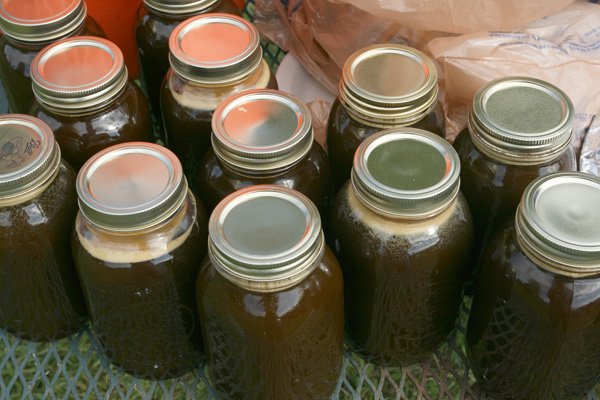
       Yes, I have been looking forward to sharing the photos from last Sunday's "cook down" which was done at the old home place.  And good fortune provided morning fog!  Therefore, instead of sun creating shadows and too much contrast, for several hours there was interesting light.
      Today's post is mostly just photos with captions, because I've tried to fit in the entire "rest of the story."  I didn't get to use all the images I have, but surely a dozen of them give the flavor of things, so to speak.

overview: stalks from the trailer to the boil table by way of being "squeezed"
hound help!
squeezing the juice from the sorghum stalks  -- David, the mill's owner, has altered his 100 year old sorghum mill this year to slow down the force of the tractor which is now being used instead of horses or mules.
filtering the juice before it passes into the black hose and down the hill to be boiled
the beginning of a day of keeping the fire going and the juice moving
later in the day, thicker sorghum, closer to being skimmed enough to fill a jar
keeping the fire box filled and burning, all day

sun's coming out, it is hot, sorghum winding down

tools for skimming and for bringing the molasses through the sections, ready for the jars
one last filter, then into the jar while still hot so the canning top will seal

      My thanks to everyone for tolerating my camera while you worked!!  These photos are more of a record of how things are done than they are art, but it is hard to do even this much without the generosity of the people being photographed.  If there are inaccuracies in my descriptions, I hope someone will let me know.  I enjoyed being with you all very much.  And the fog sure helped the photos, and my stamina, believe me.

Sunday, September 25, 2011

now for some sorghum photos!

post #54
     Last time I took photos of sorghum making was 35 years ago, with a simple film camera that let in light!  This weekend, when the call came, I took my digital self to the sorghum field, yesterday.  Then, this morning, with the fog still on, to the farm near my home where they are spending the day boiling down the juice squeezed out of the stems to make sorghum molasses.  I plan to return there later this afternoon to take some more photos, including ones of jars being filled.  I use every such opportunity to learn something about this witness photography I do.  Yesterday it was that my 70-300 mm lens, which can make things look closer together, did exactly that when four guys were cutting the stalks.  The result was that they appeared to be working too closely to each other, and with big tobacco cutting knives!  It looked unsafe -- when in reality all was fine.
    Here are some photos so far, from yesterday, and I will do a part 2 next week:
sorghum patch being cut, stalks put on a trailer for transporting to the farm


more cut stalks
the pile on the trailer gets higher!
asking me, do I want to help!!??
the tops (mostly seeds) cut off, some to be used next year, the rest left for the turkeys


      This week's sadness includes the death of two fine friends, both from cancers they tried their very best to tame: Jo Carson, a remarkable and visionary writer living in Johnson City, TN, and John Kelley, married to my close college friend, Liz, living in the San Francisco area.  I don't usually share any personal stuff on this blog but I can't help today wanting to acknowledge their passing, and the fact the world has been much enriched by the grace of their presence and by their courage.  
      May I suggest, please take a photo today of someone you love.  Do it every few years. 

thinking of Jo and John last night, on the lake, and of the ripples of our lives