Sunday, September 18, 2011

tobacco as art, part 2

post #53
     Well, let's get smokin', 'tis the season to cut tobacco and "house" it in a barn!  I am sharing some additional photos today of this crop which was formerly grown by many small farmers where I live in northeastern Kentucky and is now grown only by a few.  I will try to put this week's set in more or less chronological order.  

truck bed with flats holding plants now big enough to be put in the ground (see last week's post for a photo of tobacco being planted)
newly planted tobacco in Donnie's field, a photo whose title is "earthbound book"
This tobacco is overdue to be "topped" and de-suckered....sticky, hot, hard work, with bees for company
I don't usually see tobacco blooms this far along, and, not having to work it, I thought it lovely.
 
The yellowing means the tobacco is getting ready to be cut and housed, usually in late August or September.
The earthbound book field, in September, with some of the rows cut, the plants left a day or two in the field to dry out a bit before all that lifting to come
Trailers bring the cut and speared tobacco plants to the barn.  The tobacco sticks (see some unused ones lower right) are used as spears, thanks to the cutting cone that gets moved from stick to stick.  Five to six plants each are on a stick, which is later placed on the trailer to be taken to the tobacco barn for hanging.
unloading the trailer and hanging the sticks holding the plants
hanging to cure  (barn built in 1960?)
 The plants hang like possums for a couple of months, depending on the weather, and then the leaves are stripped off the stalks. 


a favorite photo of mine, see my post #7 -- Sandy, Junie and Dorsie stripping their last ever crop of tobacco, two years ago
Donnie spreading the stripped stalks back onto the fields, before winter snows, with his daughters keeping him good company

    My explanations here are very basic.  I hope my neighbors don't laugh at me.  But the amount of labor required is hard to understand without some explanations of the yearlong process. I will appreciate hearing about any confusions, errors or needed clarifications, which I will then use to make this a better post!  
     As always, thanks for your interest in this blog  -- I hope you found some art among the stalks and the seasons.  Too bad the end product of all the work is not as fascinating. 


Sunday, September 11, 2011

tobacco as art, part 1

post #52
Welcome to the coming of fall -- which means our black walnuts have begun to fall onto the deck!  There is random clunking heard day or night; all will have fallen by the first frost.


        Fall, however, is just one of many seasons for TOBACCO, the crop I have photographed over the years because it is so much of this place and so interesting. I am lucky to be allergic to smoke, so I have never smoked. In fact, I disparage smoking.  But for many years we had a tobacco base.  That means we were allotted and allowed to grow so many pounds of tobacco per year.  We didn't grow it ourselves -- we leased it to our neighbor --and we never earned very much, but for a long time having a base that was used yearly made a farm such as ours more valuable if we ever wanted to sell.  Turns out we've stayed here so long that by now the way tobacco is grown, if at all, has completely changed.  
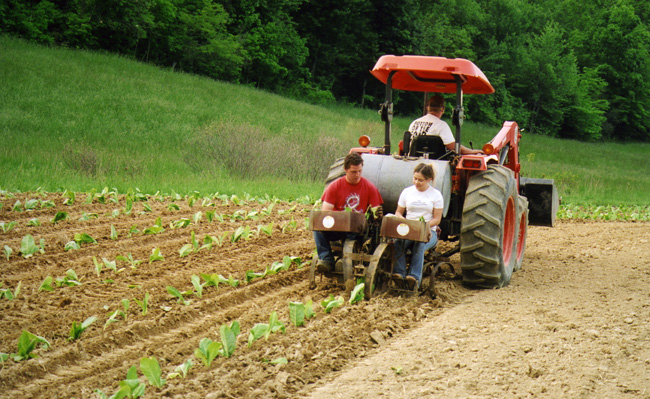
planting tobacco plants that have been grown in a covered bed (the seeds are minuscule.)  Notice a plant being  placed into a kind of chute while the tractor moves slowly down each row.  Several parts of the process are going on at one time.  In earlier times, they were all done by hand!
    Changing economic times, however, are another story, for some other time.  For now, I mostly want to share some of the many photos of tobacco that I have taken over the years, in different fields, with different neighbors, and during different seasons.  Today images are mostly from the months of May, June and early July.

first plowing, in 1997, ammonium nitrate on the field, rare view of 
how things were done "in the olden days"
 

way back in the woods, an unexpected field of early tobacco


Two years ago I was invited to take photos of this team of mules since it would be their last time doing this annual job.  The spring had been so wet that the tobacco was farther along than usual for this first plowing.  The mules are 21 years old.
side view
back view
"teen-aged"  tobacco plants
reality moment in the tobacco field --  what it is all about...


        Speaking of reality, a mention here of the national upheaval this weekend while the world observes the tenth anniversary of 9/11.  I am clearly sorry for so much loss of lives.  I am also sorry for the way this tragedy seems to make it even harder for too many people to think with nuance.  Instead there is a rush to an either/or, good/bad, right/wrong way of thinking.  That's when sound bites have way more power than they deserve, as we give up our right to figure things out for ourselves.  Democracy's challenge and strength is to be inclusive, which requires we use our brains and facts to be informed and therefore to keep it strong.   
       
     Next week I will share some more tobacco photos --for now, two more, taken last week, with my new little waterproof camera which I am trying to learn to use correctly.  The first shows a field (and a bit of a barn) waiting for the rain to stop before getting cut, and the other a recently cut field with some of the cut tobacco visible hanging in the barn.  
     Tobacco is still happening here, but each year there is less and less grown.

Elliott County
Morgan County (still learning about my new camera settings...)  Here the plants have been cut, and stacked in the barn.  The section of the side of the barn is open, as well as the barn doors, to give more air for the drying of the plants.  Too much rain can produce mold on the plants.  Tobacco requires day by day tending.

     I feel this is a good example of holding two truths at once....I hate smoking and all that it does to people I love, but it has provided an on-going honest and honored living to many families I know.  For small farmers, it requires hard work every month of the year.    However, I can't resist a final clarification: I took many of these photos BECAUSE they show something unusual or interesting or disappearing, but NOT because I believe in the big profits corporations have been making off of the addictions caused by the cigarettes they produce.  Stay well everyone, and thanks again for reading to the end!

Sunday, September 4, 2011

before fall -- follow-ups

post #51 
     Blogger.com presented us millions of bloggers with a new look this week.  I believe the changes will only show up behind the scenes of what ends up published.  But, just in case there are some surprises,  I'll use their shift as an incentive to finish up some of my loose ends.  I will start on my new series -- making art out of tobacco -- next week.
    SO, early one morning, the very day following my second spider post last month, I just happened to notice the largest spider I have ever seen in my non-zoo life ON THE FLOOR, actually on the carpet, in front of where the TELEPHONE is, and I was bare-footed!  But since it didn't then rush off, I decided to try to scoop it up.  I chose the largest, sturdiest glass I could find and bravely and calmly (!) lowered it over the beast, who seemed to be carrying a soft whitish roundish item under its belly.  In case this amazing visitor decided he or she would hide if I took time to search for shoes, I was still shoeless. 
    Then, as happens, I reminded myself that I was a photographer now, unlike when years ago my husband and I came across a recently vacated bear bed on Kodiak Island in Alaska.  We didn't even think to take a photo before starting to make lots of noise and skedaddling away from there.  Anyway, I positioned the assemblage on a kitchen counter by scooting a piece of thin cardboard under glass and spider before moving it.  The spider -- which my laptop and I figured out was a wolf spider -- never let go of what's now confirmed as an egg sac.  
      Here is "Wolf Spider under glass":
At first I didn't realize one leg was caught... I also found a way to let some air in.

      Hours later, after my husband had a chance to see the creature as well, we took it outside.  Here is "Wolf Spider let out far away from the house, still with egg sac":  

I was wearing shoes by now, but didn't have my tripod, so the two closer legs are out of focus.  Big Mama!!
      One of the descriptions of this voracious insect eating monster is that it is harmless but nonetheless very disconcerting to home dwellers who occasionally encounter one..... I'd say!!  I hope the spider family didn't suffer from my curiosity.  Really, I felt admiration.  (Last week I saw a reference to a wolf spider in a children's novel I am reading.  I figure the author must have seen one, too.)

     Another unexpected fascination was this large fungus/mushroom that appeared one day, and was gone the next.  I am so glad I didn't put off taking a photo.  I know nothing about kinds of mushrooms, and I never dare to eat one.  But they do make me think of fairy tables or shelters in the woods.
side view of a porch overhang?


      A favorite Kentucky wild flower of mine (and of hummingbirds) is out.  I took this photo of some cardinal flowers along the edge of the pond.  The red is harder to make work in a photo than I like to admit:


Three final bits
      1. BTW, I can now report that the blogger folks did make some improvements.  A couple of tools available as of today make the process go more smoothly and are not at all intrusive. THANKS.
     2. I am giving a link to a basic article on CNN about photo journalism tips -- there is usually something helpful in another photographer's experience.   Even so, I have to learn stuff by doing.  I don't seem to be greatly skilled at taking advice.  (Sweet family, please do not laugh.) Note: here's a September 6 deadline for some submission to something.
      3. I am not much of a gear geek, but this week I finally bought a waterproof point and shoot, my first.  I haven't liked not being able to take photos when it's wet out.  I had hoped to share one of the new photos tonight but am having some Mac vs PC issues.  Therefore its planned grand debut for this blog will have to wait.  Stay viewed!!  

    Instead, here is one last photo from the summer: hollyhocks along a neighbor's fence.  I like the unusual location for the hollyhocks, and the recently mowed field in the background, with contrast between the straight and the curved.


Sunday, August 28, 2011

Kentuckians for the Commonwealth

post #50
    I have been gratified that, for whatever reasons, so many of you have been interested in the funeral photos by John Flavell and myself in last week's post, #49.  Thanks too for the comments.  As we get riveted by such out-sized things, like hurricanes and earthquakes and national financial quandaries, it helps to be reminded how sharing and caring with our neighbors, friends and family keep our lives grounded even or perhaps especially in times that hurt.
     Yesterday I was in another situation where the strength comes from helping one other -- I was part of  the 30th birthday event of a statewide organization I am very proud of, Kentuckians for the Commonwealth.  KFTC got its start working to stop the abuses of the broad-form deed.  It took many people all over the state to change the law in the early 80s to keep coal companies from taking the top of the land when landowners signed over their mineral rights, for which they were paid very little and the surface of their land was stripped.
     Some of the issues KFTC works on now are preserving streams so our water is not ruined by mountaintop removal mining ("We all live downstream"), establishing voting rights similar to all the other states for felons who have done their time, and identifying local issues that affect the health and safety of ordinary people living there.  Developing local leadership is key.  Here is their website,  www.kftc.org; their main mission is to build a new balance of power and a just society.
     Soon after I arrived, the light on the porch where some of us were gathered was right for photos, so I just couldn't help it.  Had to take some photos, even though none were needed.  (Also, I like it when I can be fairly unobtrusive.)  Therefore here are a few photos taken mostly during the afternoon session called Sharing Stories -- of which there were some from each of KFTC's three decades.

I call this "Three of the Greats", early and persistent advocates for change: Daymon, Patty, and Ruth.
John Rosenberg from Prestonsburg, present at the very first gathering which identified the need and the possibility of a statewide social justice organization, named at first "Kentucky Fair Tax Coalition".

Ray Tucker, with Teri Blanton in the blur (Sorry, Teri!)
effective poster for the broad form deed constitutional amendment, which passed!  Thank goodness!  And thank you everyone who stuck with 1986's enormous effort statewide.
Ada Smith, an active long-term advocate for social justice, i.e. since childhood!
Kristi, now on the KFTC staff, shares her story.  Thank you, Kristi.
Burt, commenting on Daymon's wardrobe preferences....


Doug Doerrfeld and K.A. Owens, two other former chairpersons, during the part of the late afternoon general gathering that honored all nine of them.
Now, last, a view along Route 213 in Powell County, on my way home.  I love Kentucky.

Sunday, August 21, 2011

sharing photos by John Flavell, from a funeral

post #49
       My friend, photographer John Flavell, was interested when I told him in June that my neighbors were planning an unusual tribute for Dempsey, their father and grandfather.  They had hired a wagon, pulled by Betsy and Chester, and driven by Terry, to cover the last two miles of taking the casket from his funeral to the family cemetery, located on the old home place.   John agreed to join me there, and he was able to use a couple of his photos in the newspaper he works for -- one on the front page.  He has recently sent me a few additional ones, which I am putting on this blog so that the family members can see them as well. 
     The day before, a Sunday, I had shown John the route the wagon would take.  Then on that Monday the weather ended up being cloudy, with some sprinkles, which makes for good light as long as it is not raining too hard, which is what it did during the funeral.  In fact, we weren't sure the wagon pull was going to be possible.  I also took some photos that day, so John's images here tell his story.  It is what he saw and how he saw it.


arriving at the cemetery

Papaw

       I too enjoy the part of photography that leads to stories told.  The trick is to blend the photo-journalism impulse with making more than a snapshot.  Making art.  Allowing the viewer to see something in a fresh way.  In addition, this time, there was a personal connection, permission given, appreciation expressed, a quiet, steady two miles over a back road on a drizzly day, and a family pulling together.
     I thank Dempsey's family for asking me to take photos and for their willingness to share this tribute in a public way.  So this last photo is by me, and it is the one I had in mind to try to make:   


Sunday, August 14, 2011

more web words and a tribute to Norway

post #48
      After posting my spider poem last week, I received two wonderful "connected" poems.  So, with thanks to Maureen, I would like to share the one by E. B. White:

The Spider's Web
 
The spider, dropping down from twig,
 Unfolds a plan of her devising,
 A thin premeditated rig
 To use in rising.

 And all that journey down through space,
 In cool descent and loyal hearted,
 She spins a ladder to the place
 From where she started.

 Thus I, gone forth as spiders do
 In spider's web a truth discerning,
 Attach one silken thread to you
 For my returning.


       I googled this poem and learned that it was first published anonymously in 1929.  Since EBW happens to be one of my all-time favorite writers, I have to confess that despite the fact I can't read the end of Charlotte's Web without wet eyes I love his delicious and subtle sense of humor.   (I was somewhat mollified about my own tears when I heard the author himself, during an NPR interview, tell about how it took him many tries -- I remember "17" -- to read that ending aloud for the audio book, without choking up.)

    But this is meant to be a photography blog!  I am going first to include a few fun images, mostly recent, to celebrate some of the many facets of this profession:

     a witness to unexpected cultural shifts --
This is a small railroad station in rural England!  But who showed up needing info while we were there?  a female Japanese, on a Sunday afternoon, when the station building was closed!  No available Ladies Toilets....

and population shifts, in rural Kentucky.


Also a witness to nature's wonders, in this case trying to show by looking down from above how long these stems are --


rattlesnake plantain
and how tall the trees --
an extremely warm and humid July evening
and how to make a squirrel eating an apple look like art instead of like the pesky rodent he or she really is.  His task went on long enough for me to go downstairs to get my camera and then return to the bedroom window!  I still don't know how a squirrel gets the apple up into the maple tree.  Can anyone help me with this question?

       As for the deer, who are beautiful, they are still like rodents!  Just ask our sunflower plants and the corn we didn't bother to plant.
one of the twins, with mama doe nearby
      Photography can also give an image to accompany our deepest joys and our deepest worries.  I haven't spoken yet on this blog about the tragedy in Norway, a country where several close family friends live or are from.  I was in England when the killings took place. I was deeply distressed and saddened, especially by the deaths of the young people connected by their willingness to work for a better future for their country. I am so sorry.  
     Since I started today's post with webs, I am pulling up two more web views from our Appalachian woods, as a way of expressing the on-going need we all have to connect, to trust, to work together -- and to work hard at doing all that.  Through this effort, we can honor those fallen Norwegians, their families, and their wonderful but wounded nation.  


Each web is a sign of hope for a new day.

Sunday, August 7, 2011

a writing poem

post #47
        I'm still at home, getting back into the nature dramas here, remembering that August was the month when we were transfixed by a spider who had built a web outside our window, a web that had zigzags in the middle.  It is also the month when this spider secured two sacs nearby but above the web, and, just like Charlotte in E.B.White's book Charlotte's Web, then the web builder died!  That was when I figured out that I had taken a photo of this kind of spider several years earlier, near our pond, and that one of its names is a writing spider. 
       
      Here is the photo in black and white:
      
     Here is the photo in its original color:

      So now the poem:
  
     
                 zigzag faith


For weeks we watch outside

the window, our spider writing,

wrapping prey, hanging

round sacs of eggs

east corner first, then one

high in the west, a mama

ever purposeful

even when at rest,

argiope aurantia.                                                [R guy oh pea/ or ranch a]


By her size we know

she is a she,

by her work she shares

her silken faith,

since we’ve no vegetation

to protect her, only glass

behind, the woven web

her shield and show.


She’s not yet gone frail,

not yet gone, leaving

us to watch both sacs

until the spring, a time

to hope, to know

her thousands plan

to float on air, as Wilbur

taught me years ago

when what I needed was

to know his love for Charlotte

and hers for him, shown

by words, in truths she told.


Now I’m taken by this steady

work, she who weaves on

and on while I stop,

go, debate, consider. 

Yet she but wafted in,

like me, her long stay

a sign of settling where

a writer needs to be.


   note:  The reason for showing both versions of the photo is to see which one shows the web design better.  I am drawn to the shapes of webs.  And I am so much a color person that I don't usually even try black and white.  I came to photography in the last 15 years and so never went through the dark room phase.  It was slides, then digital.  Also, webs are hard to get as sharp as they look since they are always in motion, responsive to every breath of air no matter how still the day.  Even the body of the photographer in the vicinity produces a quivering. 
   This is a good occasion to thank my monthly writers group for our years together and for the sharing of encouragement, help and words!