Showing posts with label mountaintop removal mining. Show all posts

Sunday, November 8, 2020

Outbreaks of Happiness

post #516

            Words seem necessary, but this long, long week speaks for itself. Well, first, for weeks, we saw the long, long lines that people tolerated, everywhere, wearing masks, sometimes waiting for hours and hours, to VOTE YES to have each one's VOICE be a part of our constitution's presidential every-four-years schedule. We had mostly good weather, except for a couple of hurricanes or simple heavy rains, and also fires. All that with the virus, ready as always to take you down. 

        Physically I couldn't have easily done what those voices did, though I like to think I would have tried. Luckily, in Kentucky, where I live, early voting by mail could be done by request for reasons of age or concern for the virus, so that is what I did.

        Now we are processing the outcome. For those of us who can not understand the Trump appeal, we were astounded at how strong our sense of relief has been. That's why so many hit the streets Saturday afternoon and evening to dance and shout. It was a joy that just had to be shared.                                    

       I do want to share also that this week I heard from my Japanese friend Mariko, who married a Frenchman and lives in France, and her cousins, who live in California and New Hampshire.  I also heard from Reidunn, who lives in Oslo, Norway, and from close friends in England, Bill and June. Knowing my feelings EACH ONE expressed happiness that the mean guy had not been re-elected. They were thrilled that Americans were not continuing to go down the road of being cruel, cut off from the world, and [governed] by chaos. Another Norwegian friend, Kjersti, now living in Canada, called last week distraught about Trump's behavior and calling the damage he continually causes incomprehensible.
       I hope to have future conversations, with whoever wants to really talk and listen. We need to figure out how to work through with friends and neighbors where the disconnects occur.   

      OOPS, I've talked way too much. My bad. I planned to show some photos from my life as an American choosing to live in rural Eastern Kentucky. My America. We are all part of the work that a vibrant democracy requires.  As my friend, Melva, suggests, we should construct a political party that is called "Common Sense."


 This set of photos is going to take at least two weeks to show. They are mostly in order of date, but somewhat grouped if connected by topic.  I call this first photo "story line." Cathy K. worked at the sewing factory that used to be in Olive Hill; they made jeans.  It's one of my early photos from when I started making photo note cards.


a worm eating warbler who must have been sitting on eggs she didn't want to leave

mother LISTENING intently to daughter

looking for mom on those same steps


a mom competing with the rash of younger family members using months for their ages.....


This is the consequence of mountaintop removal mining, near Hazard, Kentucky, the photo made while I was in a small plane. The health of our earth is at stake. Believe it.

on our land, lady-slippers, no longer in that same place, the land is changing


        I want also to touch on families, everywhere, and the security they can provide, and the importance they play in lives lived. I don't know if turkeys love each other, but they sure do hang out together.  This first gathering took place essentially in the yard outside my house!


turkey families on an outing

We call this gathering Cousin Camp.... There are stories.....


                I think I will save the other photos for next week - This has been a long week and it's not over yet. I know I have shown most of these photos before, but they look different to me after the import of the last few weeks. I just am so grateful for where I live and for all who are in my life and for discovering I love to take photos.  I'm also grateful that so many fellow Americans got it together to go vote this year, enough of us to cause a change in the direction our country was headed.  I do believe that if we are patient, and if we listen to each other, we can go beyond how partisan we have become.  The first task may simply to be to examine what truth entails and why it is so important to our lives. Please, everyone, don't give up on the inclusive core of our American dream.   

              Special thanks to everyone who helps with the consequences of the virus -- Ann


Sunday, February 17, 2019

February 17 now and twice before

post #419
       YEA! Fun with the past!! Two earlier times on February 17, and one shout-out to Nik, who is 23 today, and to Sarah who is also having a birthday!!!! Can't wait to share these photos on this rainy day.

FEBRUARY 17, 2009 
     Location: Frankfort, Kentucky (our state capital)
     Occasion: A demonstration organized by Kentuckians for the Commonwealth (KFTC) against the destructive practice of getting coal out by mountaintop removal.....  This practice still happens today, but with more scrutiny. Still, residents continue to pay the price of not having reliable clean water, of increased illness from the dust in the air, and from the destruction of the habitat our lives depend on. In 2019 KFTC continues its advocacy for a better Kentucky. Bravo!

I hope these young people I shared a van with haven't given up on participatory democracy!!!


Doug

Randy

In the middle is wonderful Patty Wallace, determined activist from Louisa, KY. We truly miss her.

George Ella  and Kate, singing for the crowd, on the steps of the capital

Ashley Judd also joined us that day, with her usual eloquence and directness. .

NOW on to 2015, when we had a major bit of snow.  In fact, for here, it was a memorable week of winter weather.  However, I have chosen photos only from the 17th,,,,


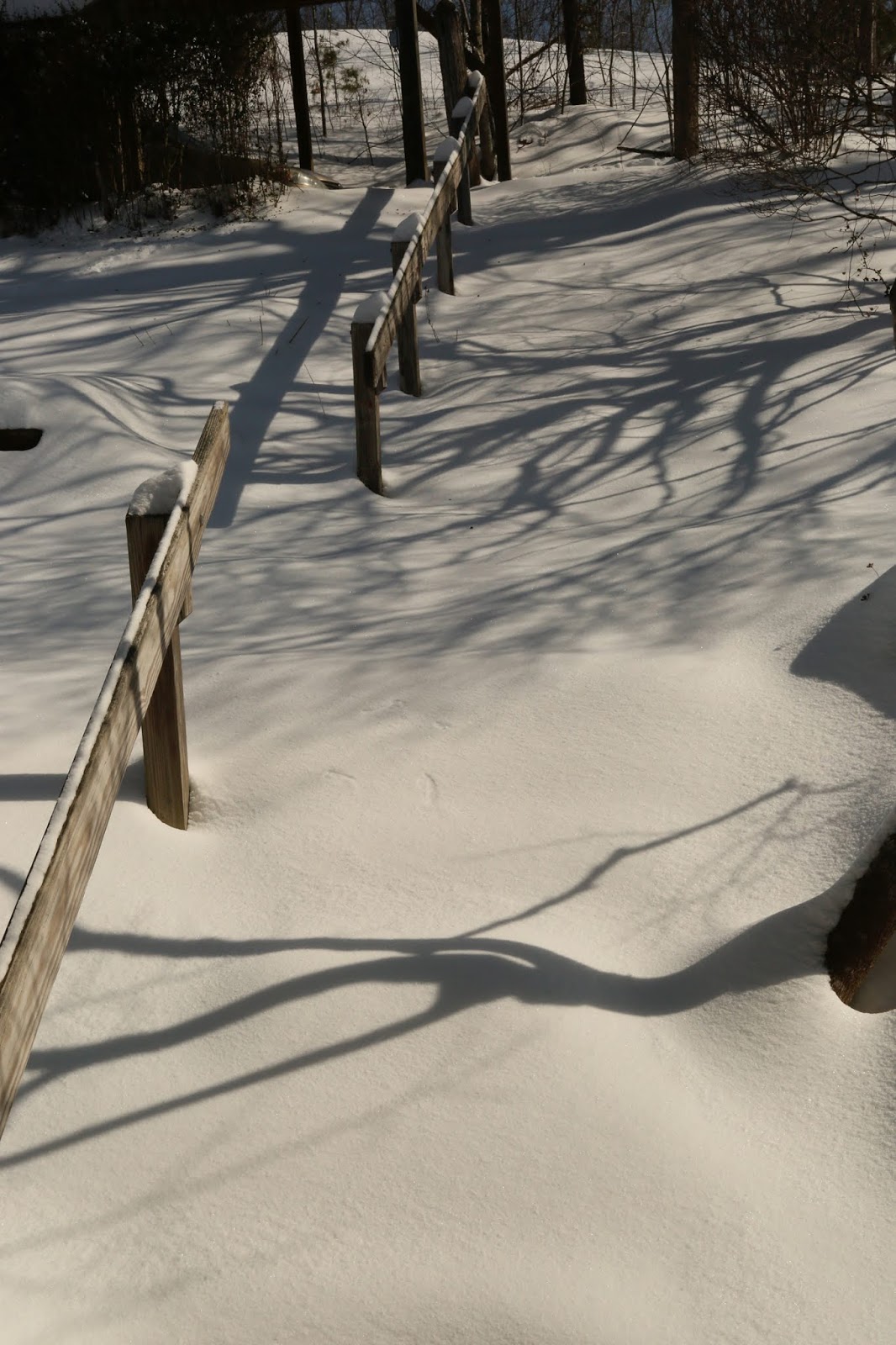
This photo is to record the temperature....
"mountain range" on the deck


blade behind = a snow removing blade by going backwards


snow covered steps, really!


            And, now for the EVERY YEAR FEBRUARY 17 folks, both Nik and Sarah, you know who you are, and you are in my heart today, wishing you all the best, today and every day.   xoxoxoxox  

Sunday, February 11, 2018

Seriously, a post about coal in Appalachia and America

post #373
         I discovered a well written, well thought out post this week about coal and Appalachia. It absolutely has to be shared. So, dear readers, this week, for a change, I'm not leaving this article to a link. 
         I'm also sharing a single mountaintop mining removal photo of mine, that I made while in the front right seat of a 4 seater plane during one of the tours organized by Kentuckians for the Commonwealth for writers and artists, initiated with Wendell Berry. The idea was to follow up by using our communication skills to hold this mining practice in a brighter light.
        The airplane window was being held open for me by Mary Ann Taylor-Hall and Ed McClanahan in the two back seats. For me, the experience of viewing a mountaintop removal site felt up close and personal -- the unbelievable made comprehensible. The site is located near Hazard, Kentucky. There are many hundred more sites in the Appalachian Mountains which touch on 13 states.

photo by Ann W. Olson, with pilot and back seat help, 2004
Note: I would be the first to say that the following article appears geeky and hard to read, but the fact that I myself could read it and find it interesting and fair and informative indicates it must not be as geeky as it looks. Believe me. Or maybe I am just a sucker for really well-crafted writing.


Front Porch Blog

5 graphs explain coal in Trump’s first year

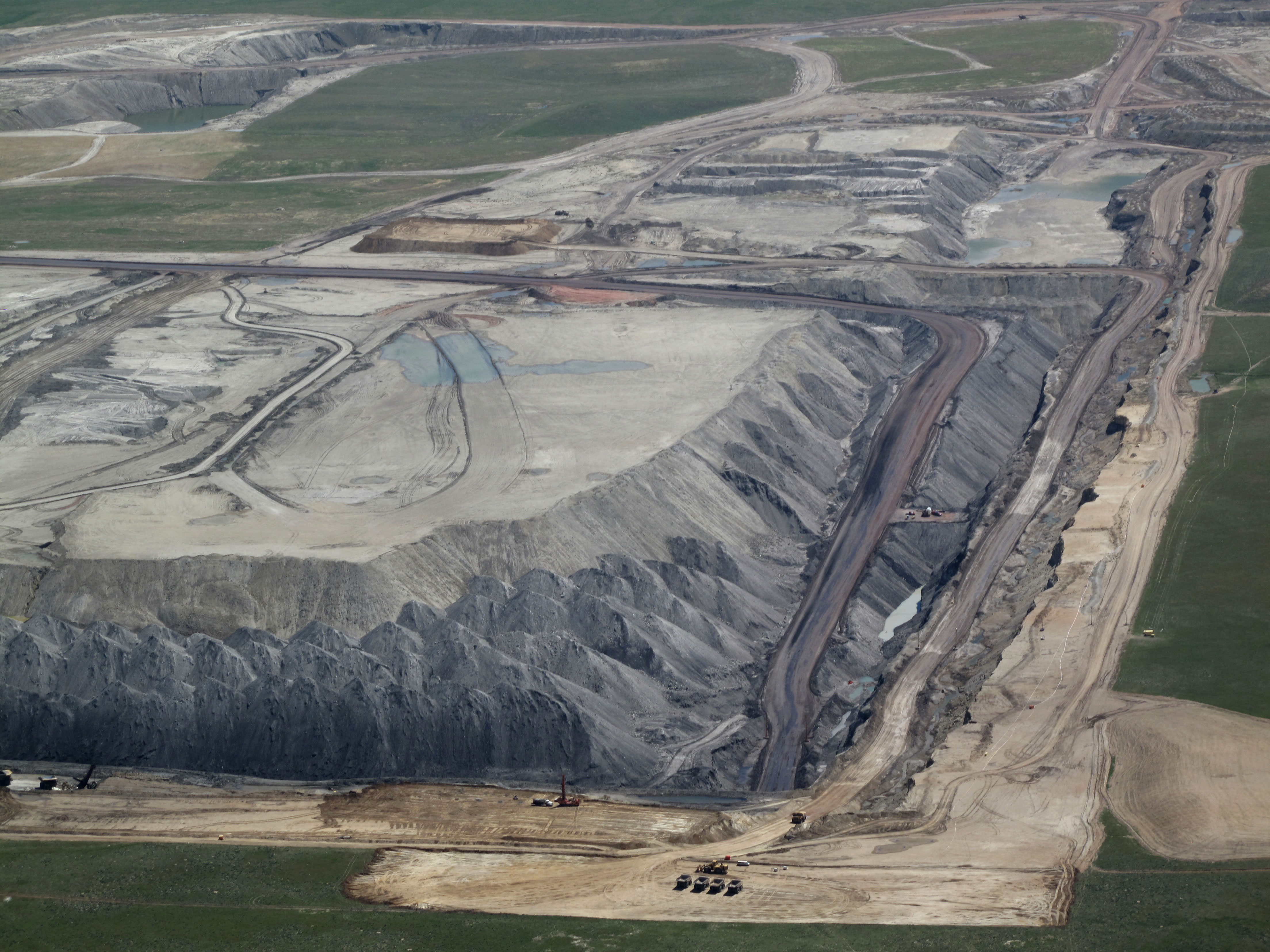
PowderRiver_ArchCoal_BlackThunderMine_Wright-WY_credit-EcoFlight
The Black Thunder coal mine owned by Arch Coal, near Wright, Wyoming in the Powder River Basin. Photo by EcoFlight

This report is the result of a collaboration between Appalachian Voices and the Western Organization of Resource Councils to assess the effect of Trump Administration policies on economic growth in coal-producing regions.       (Blogger Ann's noteHere is the article link if you would prefer it.)

By Colin Lauderdale & Erin Savage

     One year into the Trump administration, the coal industry that the president promised to revive has shown some muted signs of life. Nationwide, coal production ticked up last year for the first time since 2014, and the sector added 1,035 jobs — an increase of 1.9%. (A Reuters analysis using preliminary data from the Mine Safety and Health Administration put the number at 771 new coal jobs in 2017.) The administration claims this uptick as evidence that their anti-regulatory agenda is having its desired effect.
     Unfortunately for Trump and the coal industry, though, 2017 appears to be an outlier in which coal overperformed. The coal industry’s fortunes are tied to market demand, not regulatory actions, and the same factors that have depressed coal demand for the past decade — cheap and abundant natural gas, air quality concerns, and depleted reserves — are as present now as when Trump took office.
Many of the administration’s policy actions in 2017 were aimed at bringing coal jobs back to mining communities. In the name of restoring these jobs, the administration repealed the Stream Protection Rule, initiated repeal of the Clean Power Plan, rescinded a moratorium on new federal coal leases, discontinued a programmatic review of the federal coal leasing system, repealed a rule closing loopholes in federal coal royalties, empaneled a committee of fossil fuel advocates to steer federal mineral royalty policy, announced U.S. withdrawal from the Paris Climate Accord, and canceled a National Academy of Sciences study of the health impacts of Mountaintop Removal mining.


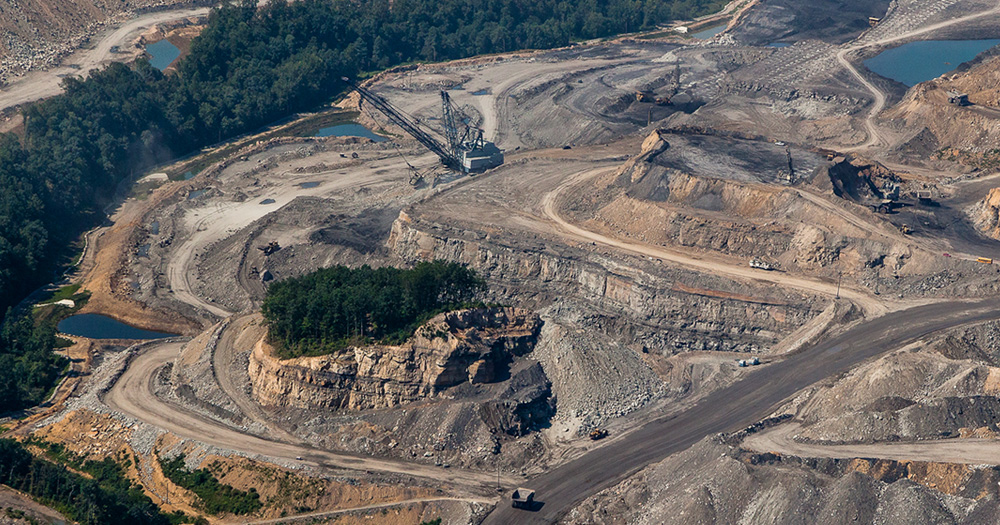
Photo of mountaintop removal mining by Kent Mason
Mountaintop removal mine in West Virginia. Photo by Kent Mason

     Energy Secretary Rick Perry also brought a rulemaking to the Federal Energy Regulatory Commission that would have subsidized aging coal-fired power plants with ratepayer dollars, but the commissioners voted down the plan unanimously.
     These policy decisions have major implications for clean water, breathable air, public health, taxpayer fairness, fair electricity markets, and everyone impacted by global climate change. In addition, the data suggests that these policy actions aren’t likely to reverse the macroeconomic trends that have been working to depress coal’s value and market share.
  
    These five graphs illustrate what happened with coal in 2017 and why the long-term trends in the industry are unlikely to reverse.

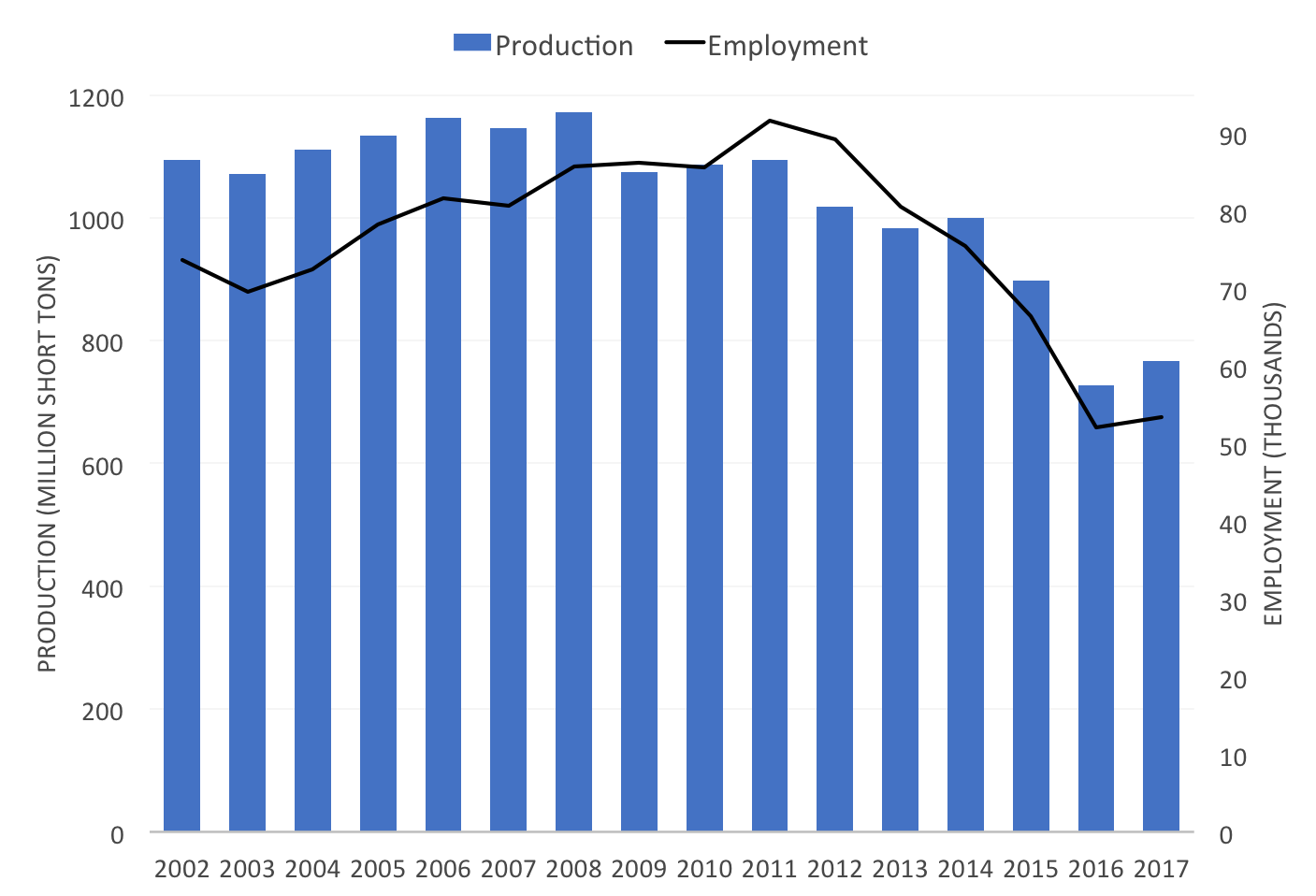
1. Production and employment went up, barely

Coal-re-Trump-blog-Feb1-2018-Figure1
Figure 1. U.S. coal production (million short tons) and employment (thousand workers) 2002-2017. Source: MSHA Part 50, MSHA Open Government Data
     2017 bucked a long-term trend in coal production as coal mining companies sold more tons of coal and employed more miners than the previous year. Both increases were marginal, especially considering that both metrics are about one-third lower today than one decade ago.
     The modest recovery in coal production did not lead to a commensurate recovery in employment. Although coal companies mined and sold about 6% more coal in 2017 (an additional 40.4 million tons) than the year before, they only hired back about 2% of their workforce (1,035 jobs).

2. Mines with fewer workers accounted for biggest production increases

Coal-re-Trump-blog-Feb1-2018-Figure2
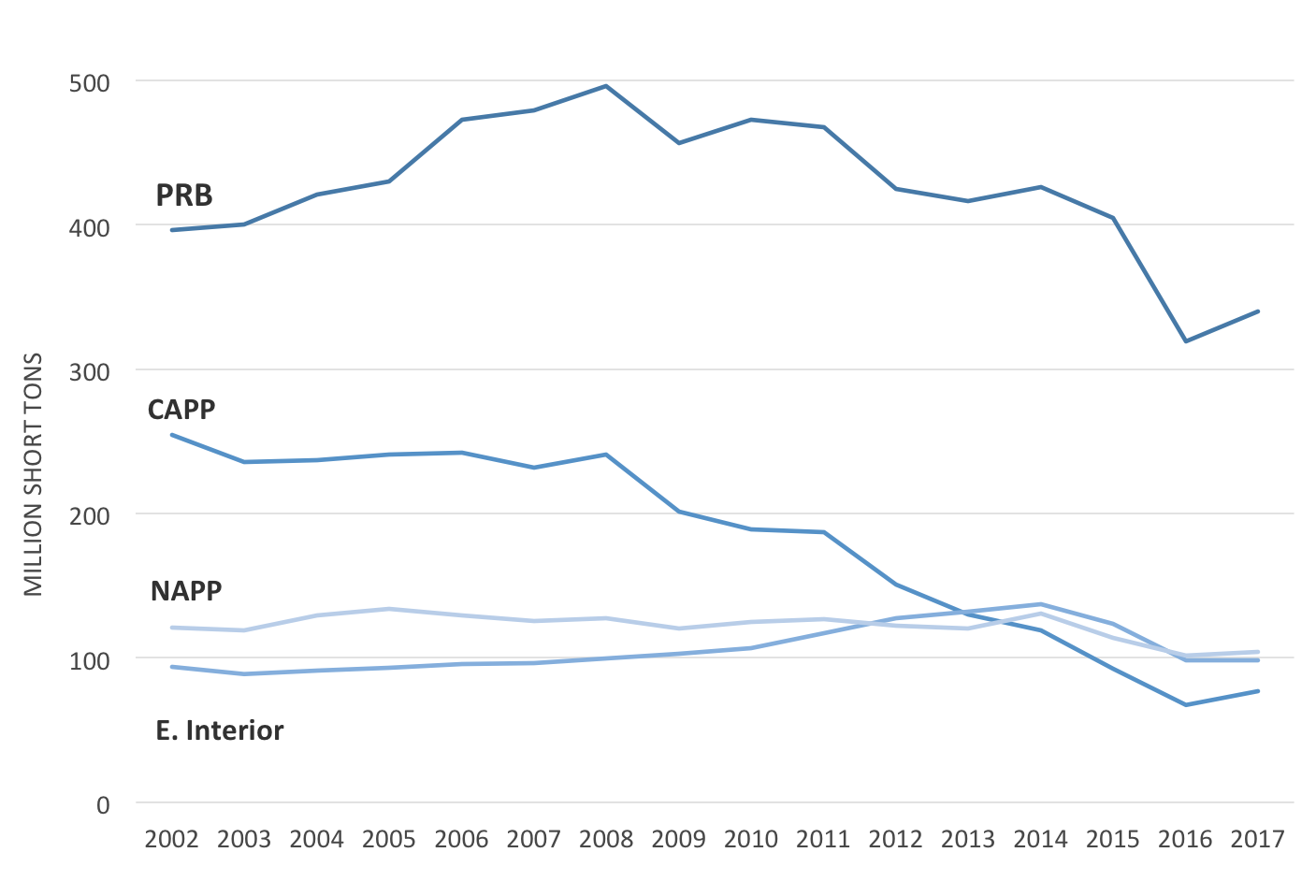
Figure 2. Regional production 2002-2017 (million short tons). Regions represented include the Eastern Interior (E. Interior), Central Appalachian (CAPP), Northern Appalachian (NAPP), and Powder River Basin (PRB) coal-producing regions. Data is preliminary for quarter 4, 2017 and production could increase slightly. Source: MSHA Part 50, MSHA Open Government Data

Almost half the coal mined in the U.S. comes from the Powder River Basin (PRB) of Wyoming and Montana, where large surface mines and thick coal seams allow companies to produce coal with fewer workers than mines in Appalachia and the Illinois Basin. This explains why net gains in employment in 2017 did not keep pace with net gains in production. Despite accounting for 51.9% of the increase in U.S. coal production from the year before, the PRB actually lost about 60 jobs in 2017.

3. Consumption decreased (again)

Coal-re-Trump-blog-Feb1-2018-Figure3
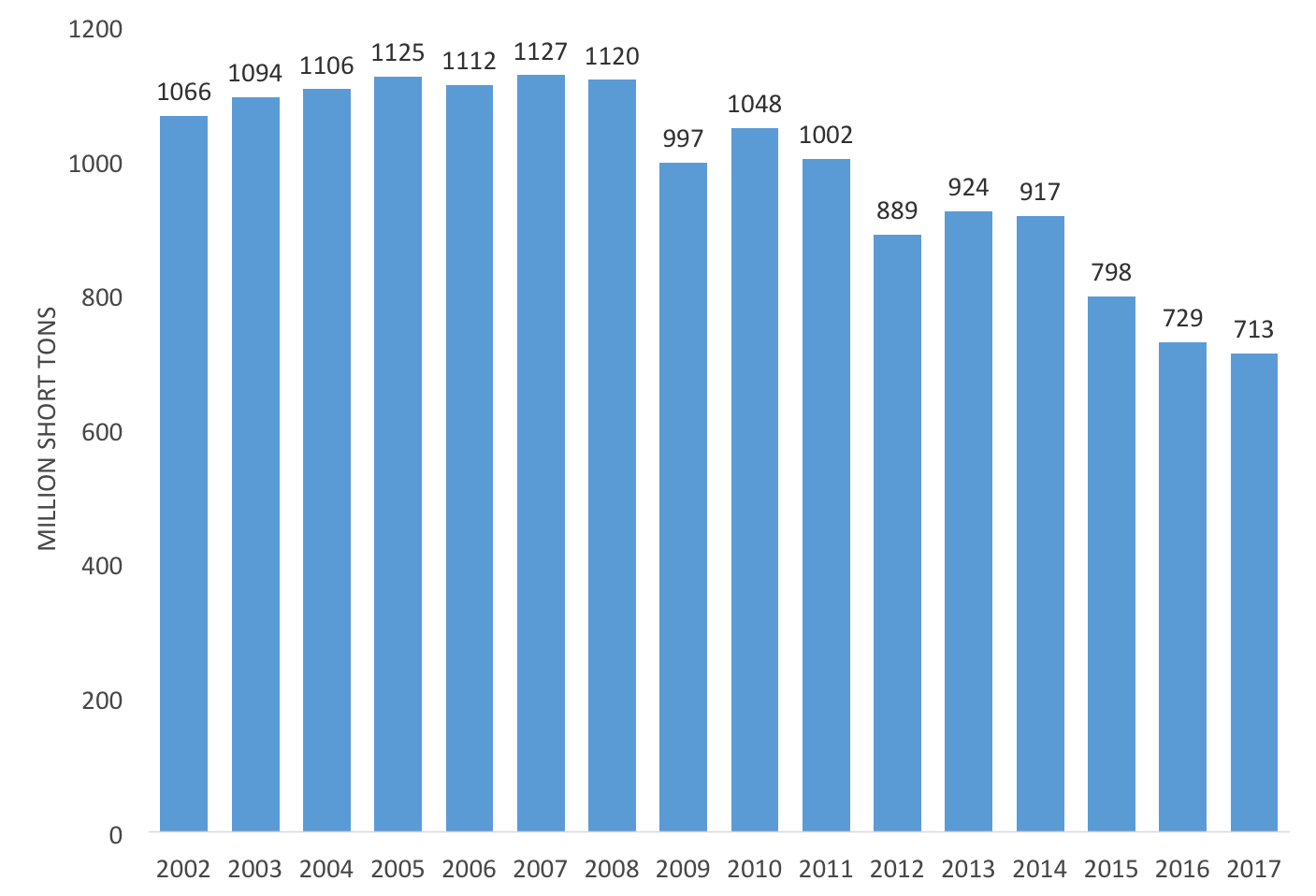
Figure 3. U.S. coal consumption 2002-2017 (million short tons). 2017 consumption estimated by Rhodium Group analysis. Source: EIA, Rhodium Group.

     Despite increases in both production and employment, the long-term trend of decreasing domestic demand for coal continued in the first year of the Trump Administration. Last year was the fourth consecutive year of falling domestic demand and marked a 37% decline from a decade ago. The continued decline comes from the rolling wave of retirements of coal-fired power plants, coal-to-gas switching at utilities across the country, increasing generation from non-hydro renewables, and a complete lack of new coal-fired electricity generation in the U.S.
     This trend is likely to continue. According to the Energy Information Administration, 14 gigawatts of coal-fired electricity generating capacity are scheduled to come offline in 2018, with no new coal generation to replace it. The Energy Department’s short-term energy outlook predicts that 2018 will be the first year in modern history in which coal provides less than 30% of the nation’s electricity.

4. Exports made up the difference

Coal-re-Trump-blog-Feb1-2018-Figure4
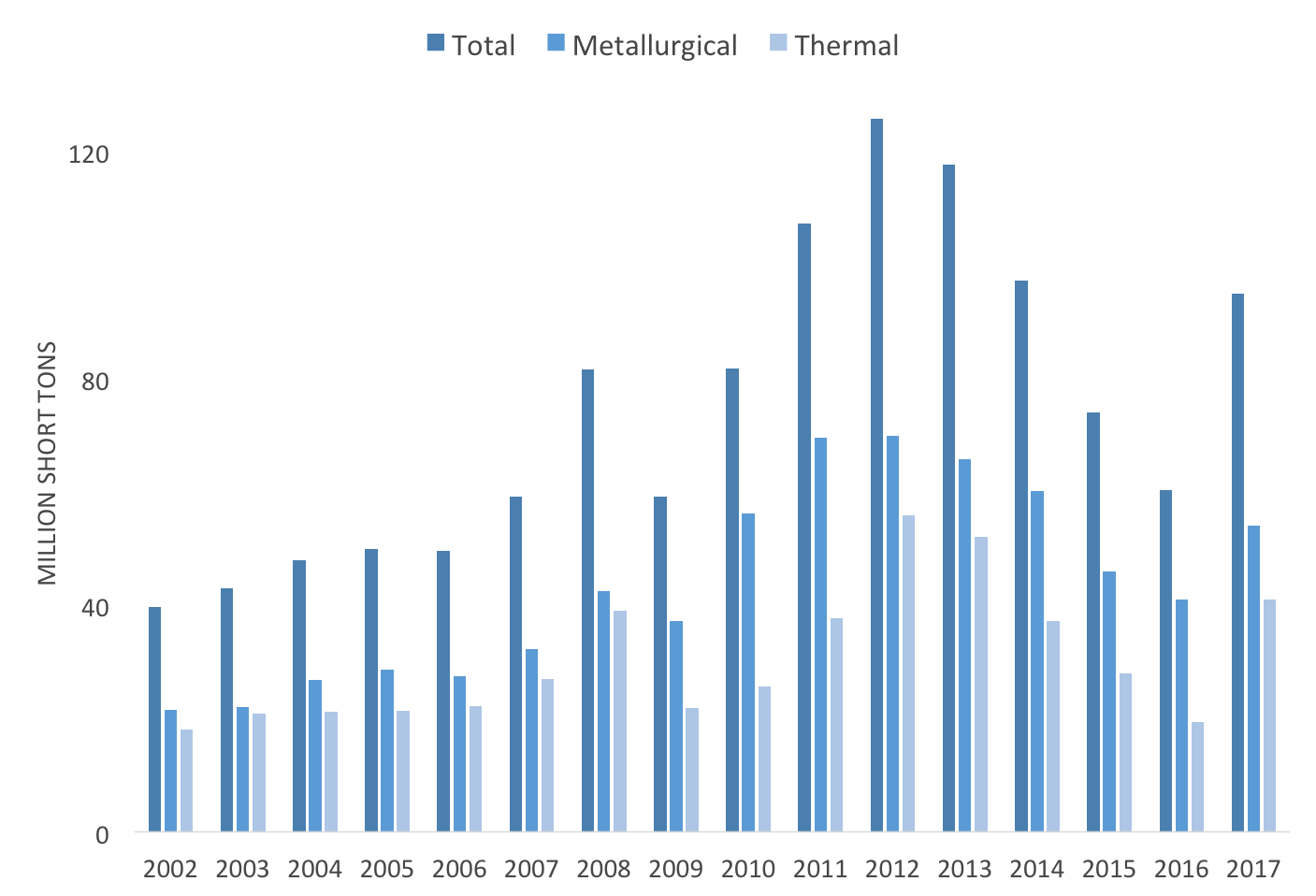
Figure 4. U.S. Coal Exports 2002-2017 (million short tons). Source: EIA

     If mines produced more coal in 2017, but Americans used less of it, where did the excess go? The answer is overseas. Last year saw a spike in coal exports, from 60.3 million short tons to 95 million. In the first ten months of 2017, exports were up 70% over the same period in 2016.
The spike was driven by rising international prices for metallurgical coal (used for steel production rather than electricity) that accompanied strong international economic growth last year. Metallurgical coal shipments accounted for 43% of coal exports in the first half of 2017, with most of the economic benefit accruing to West Virginia producers.
     Exports of steam coal for electricity also increased due to seemingly temporary factors in the Pacific Rim. The Asian market for coal swelled as China, the world’s largest coal consumer, increased imports while decreasing domestic production due to safety inspections and closure of inefficient Chinese mines. U.S. producers were able to grab a portion of this market after Cyclone Debbie shut down coal mines and railways in Australia, effectively halting Australian exports that usually crowd out American coal in the region.

5. Coal companies stopped pursuing 1.97 billion tons of new federal coal leases

Coal-re-Trump-blog-Feb1-2018-Figure5
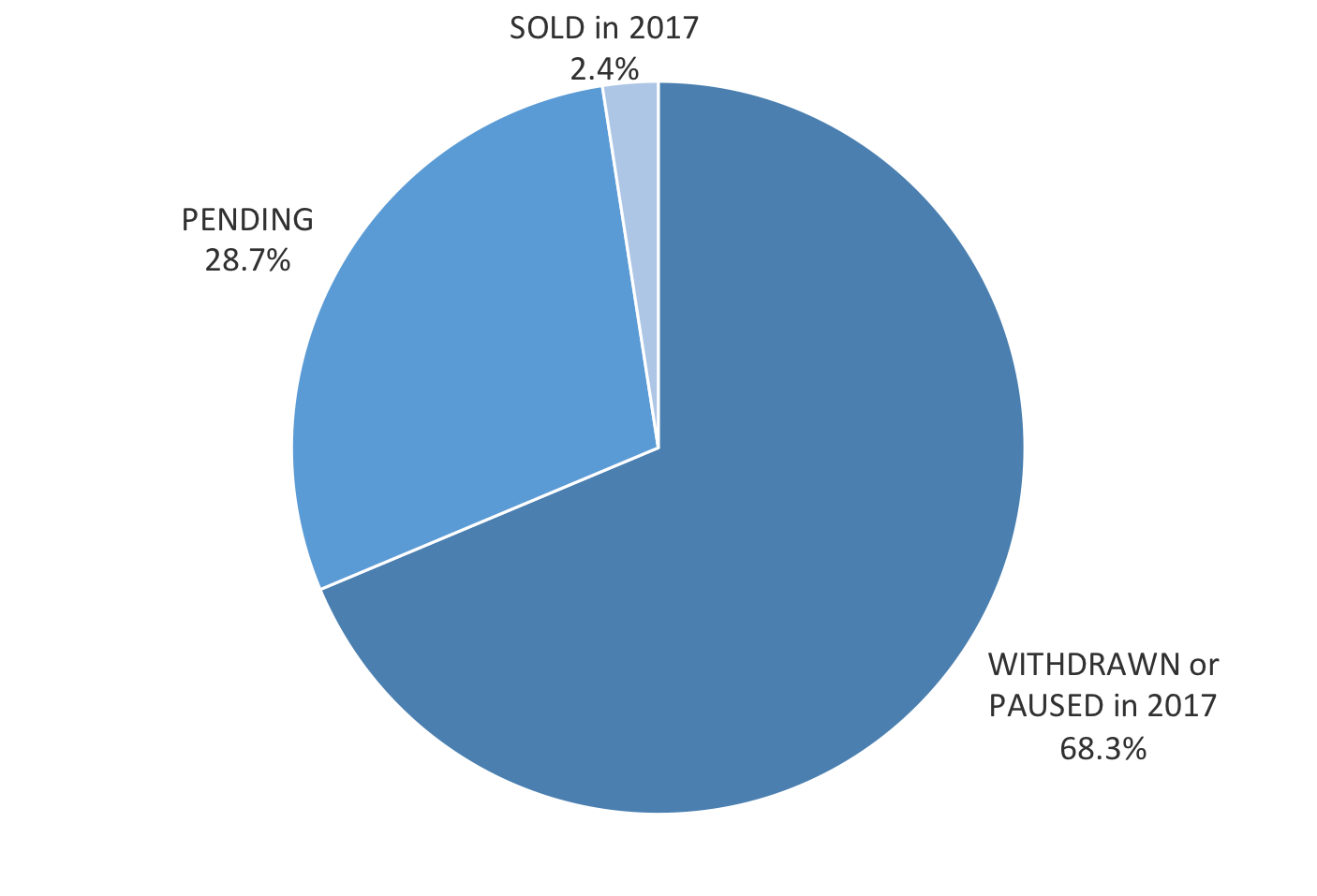
Figure 5. Current status of federal coal leases pending before Trump took office. Leases are considered “paused” when a company has (i) requested that the Bureau of Land Management (BLM) stop processing the lease, (ii) failed to provide additional information or payment required for BLM to process the lease, or (iii) not responded to BLM inquiries about continuing to process the lease. Source: Bureau of Land Management, LR2000

     Early in 2017, the Trump Administration terminated two policies implemented by the Obama Administration in January 2016: a top-to-bottom review of the financial and climate implications of the federal coal leasing program, and a temporary moratorium on new major federal coal lease sales. Interior Secretary Ryan Zinke ended both the review and the moratorium with a Secretarial Order last March, declaring that both had prevented the coal industry from flourishing.
     Coal owned by the federal government accounts for over 40% of U.S. production. There was almost 2.9 billion tons of federal coal pending when Trump took office. Since then, only three federal coal lease sales have occurred, accounting for about 60 million tons, or 2.4% of the tonnage pending. All three leases would have been allowed under both of the terminated Obama-era policies.
Almost 70% (1.97 billion tons) of the tonnage pending has been withdrawn or put on hold by the companies that asked BLM to sell the coal in the first place. These actions are a clear indication that the coal industry, at least, doesn’t believe that the minor uptick in production in 2017 is the beginning of a rebound in coal’s long-term prospects.
      In addition, last year saw one new 640-acre request for a federal coal lease in North Dakota, as well as relinquishment of a 5,226-acre parcel previously leased in Wyoming.

Conclusion

     Although we share the president’s intention to bring economic prosperity to coal-producing regions, we believe his strategy of de-regulating coal mining and burning is unlikely to produce the forward-looking economic prosperity that coal regions need. The economic headwinds facing the coal industry are the result of competition from less expensive energy sources, depleted coal reserves that are more expensive to mine, growing consumer and business demand for cleaner sources of energy, and a carbon-constrained world. Until the administration is able to solve these problems, doubling down on the economic potential of the coal industry is a poor policy for promoting economic growth.
     Coal communities deserve policies that take advantage of the coal regions’ existing assets; ensure the strongest possible standards for reclamation bonds; focus on creating new, sustainable, and diverse local economies; recognize mine reclamation as an economic opportunity; and preserve the benefits and respect that coal miners and their families have earned over generations of hard work powering our country.

Colin Lauderdale is the Washington, DC Representative for the Western Organization of Resource Councils.

Sunday, September 10, 2017

walking where a poet works

post #352
       Recently I had lunch and a walk with friends W. and T. who live on the Kentucky River. Their part of Kentucky is not in Appalachia, but, in our state, artists, writers and social action people are very connected and supportive of one another. It's one of the amazing riches that our state seems to create. I met W. with other writers and photographers he had gathered up to begin some awareness of the terrible harm done by mountaintop removal mining. Articles, poems, books, and artworks grew out of this shared effort over a long period of time. Yes, MTR mining is better known and understood by now, but the clean water and community health issues continue to be as urgent as ever. Many of us continue with this work and more.
      After our lunch and the visit part, W. went back to work, and I took a walk. It's wonderfully flat there along the river. Here are a few photos that I made just because I was happy, grateful and energized to be there on such a beautiful afternoon. Thank you, friends, as always, for your kindness and generosity and caring about so many things.


what's hot on a winter stove in August....


This looked like a grand palace entrance to me....


I love a gate and always have.


       On the way back to my car, I suddenly felt I wanted to try to capture where I was as if in a dream to take with me to revisit. So, first, here's what my eyes saw, there on the poet's path, and then I made a photo how it "really" looked as I got ready to return to a more public place. I have no idea if it works for anyone else. But, believe me, I loved giving it a try.


        There is so much to say. I hope my photos speak as well as my words might. 
        I'll save my thoughts about what goes on in the world until next week. Thank you for visiting my post this week.

Sunday, July 26, 2015

water, flowing and clear and needing protection

post #241
         Try to imagine owning a piece of property where a creek starts, emerges, one that joins up with three other creeks along its way before going over several water falls and only then leaving the spot on this earth which we've "owned" for over 45 years.  The hills on this place are like a protective circle around us, with the creek located through the middle of it all and nourished by run-off through healthy trees whose roots hold the hillsides.  We are cradled by this hollow, as it is called in Appalachia.  We are rich in our connection to the earth even if, ironically, our property's "value" is not that much.
         I have written in other places about the privilege of living on these 90 acres.  And about the job of stewardship. In this day and age even our small bit of the earth requires care as well as good fortune so that the woods don't burn down, that the Ashland Oil pipeline doesn't leak -- it is on our property but runs along the edge by the road -- and that invasive plants don't choke out the native ones that work more in harmony with the whole.  
       There is also the huge problem of it all being taken for granted. During a recent conversation in a car with three very smart local teens, it turned out that none of them knew the name of the dogwood tree then in bloom throughout the woods and along the road we were driving on!  Now they know the name.
        This is my photography blog, however, so it's time for one of the things I can do: share the love in a visual way. I decided to try to give a brief sense of the creek on its journey.  Several of the photos have already been on my blog over the last five years, but, hey, what is life anyway except seeing things with new eyes as we go along!!
        
a joining on our place


another joining, heading downstream


farther along


THE ROCK IN THE CENTER IS WHERE I WAS SITTING SO I COULD USE MY BODY TO MAKE LIKE A TRIPOD. It always amuses me that viewers are rarely curious about where I was when I made the photo.


the creek in full force from spring rains


the same creek, later in the spring, during another year


the creek during a dry spell, so strange to hear no noise from running water


same view, a bit closer to the tree, summertime


the second waterfall


   I also made a brief video, just with my iPhone, that goes for 30 seconds.  Water flowing, giving life.  The still shots from this same location are shown above. It had been raining a lot, so the creek edges are more washed over than usual.  I hope you have time to take a look.  (Note: I finally figured out how to embed a vimeo video! I am thankful to be on good terms with my close companion "trial and error.")


clear Kentucky creek from Ann W. Olson on Vimeo.


       I am not the only one grateful to feel the life force a particular piece of land provides.  It makes me ache for the families whose long held pieces of land are being abused by the extraction economy that prevails in so many places in the mountains.  The most recent outcries against more stingent regulations for keeping streams clear simply frost me.  As KFTC (Kentuckians for the Commonwealth) and other groups have been saying all along, we ALL live downstream and we SHOULD care deeply about how our water starts out. 
        With that work in mind, I am ending with a video of the song "Black Water", written by Jean Ritchie.  Jean died recently at age 92, but she spoke up and sang out in her chrystal clear voice for many years, a Kentucky treasure. I copied this video from a piece by writer Silas House that he posted on his FB page.    JEAN RITCHIE SONG: BLACK WATER