Sunday, January 15, 2012

how to be a rural photographer and learn about art

post #68
       I take it for granted that rural artists are there for each other.  While alone time is important for doing our craft, it is also essential that we interact, share ideas, and have support.  I am getting involved with FEAT (Eastern Kentucky Foothills Eco-Agri Tourism) in a five county area, allowing me to meet other artists in the region and improve my skills -- including a better web page as soon as I can!  In rural northeastern Kentucky, regional training in presentation, web design, and sales strategies can make a huge difference.
      But for the twelve years I have been doing photography, I have relied on such opportunities as museum visits, lectures at the University of Kentucky in Lexington, and obituaries (!) to help me learn more about what I like in a photo and why I like it.  (How to do what I like on purpose takes constant trial and error.)
      So my plan today is to tell about a few of these learning occasions, as I call them.
      
      The current exhibit at the Kentucky Folk Art Center, in Morehead, KY, is "Krause & Spellman: scenes from a lost america" (until March 31.)  These artists are a couple, each painting with a distinct style.  Their canvases feel photographic to me, however -- views of lives lived in a specific places.  I enjoyed the vivid colors and the variety of the faces.  This couple has a lot of work to share, and that's what it takes to build a body of work!
      
       Last spring the KFAC hosted a wonderful traveling photography exhibit called "This Great Nation Will Endure: photographs of the Great Depression from the Franklin D. Roosevelt Presidential Library and Museum."  WOW.  The greats were represented -- Dorothea Lange, Ben Shahn, Walker Evans, Marion Post Wolcott, among others -- and it was thrilling to experience them all in one room.  (Note: the link to this exhibit is not direct.  Click on the first listing that comes up, and make sure you are seeing it at not greater than 100%.)
      
      Farther from home is a favorite museum of mine, the San Francisco Museum of Modern Art (SFMOMA) with their rich photographic collection.  The exhibit I saw this fall featured a single female photographer who died in her early twenties  -- Francesca Woodman.  Her work was totally different than something I would do, and she worked mainly in black and white instead of color, which is my preference.  Even so it was riveting to see what her choices were and how skillful she was.  And what a hard worker.  The exhibit continues until February 20. 
        
     As for an obituary example, the most recent one is for Eve Arnold.  It is embarrassing that she had to die before I learned about her work.  And she was 99!  I look forward now to finding some of her dozen or so books in the library.  She was small in size but had a large impact, including in 1957 being one of the first women members of Magnum, the premium  international photo agency.  Here is one link, and here the NYTimes obit.
     Since I have been spending time recently thinking about my photo goals for 2012, I particularly like this quote of hers: “Themes recur again and again in my work.  I have been poor and I wanted to document poverty; I had lost a child and I was obsessed with birth; I was interested in politics and I wanted to know how it affected our lives; I am a woman and I wanted to know about women.”   
     I haven't lost a child, but, as Quakers would phrase it, her words speak to my condition.


Sunday, January 8, 2012

The privilege of living in Appalachia

post #67
      We've been having some unusual and weird warm January days, but they do beat a snowstorm for providing access to the woods.  Yesterday's late afternoon walk has ended up being my focus for today's post.  After all, with the weeks of essay sections and such that I shared, it has been a long time since I have posted new photos from our place.  
      I planned simply to walk, so wore my boots and, just in case, carried only my Canon Rebel and one lens (70-300 IS), but not a tripod.  However, there was no wind, with clear skies but no direct sun back in the cliff and waterfall area.  Everything was so peaceful.  I couldn't keep myself from making do and making photos.  
      Since I didn't have the lens with me which I would use to make an overview photo, here is an image in another season from an earlier visit, to give the feel of the place:
For location purposes, notice the two large round holes in the cliff, one covered by a tree top.
      What I decided yesterday was to see these falls from a different perspective.  I ended up walking in places where the path doesn't go -- which made me feel like a galumphing destruction machine.  I am a lot larger than your average squirrel or skunk; I left marks in the wet slopes just getting to this new viewing spot and finding places to sit so I could use my elbows as a tripod.  There were tender plants to consider as well.  My logical mind does know nature is resilient given half a chance and, compared to mountaintop removal mining, I know my footprint is not much, but my feeling huge made me feel my damage was huge.  On the other hand, I loved being there in the slippery, decaying leaves, watching the woods at rest and the evening starting its cover, with only the sound of falling water and a pileated woodpecker for company.  
forest floor, where, every spring, wildflowers take over


moss and roots on rock
rocks, roots and rhododendrons


a whale of a rock, looking toward the big cliff and the falls
the two holes near the top of the cliff

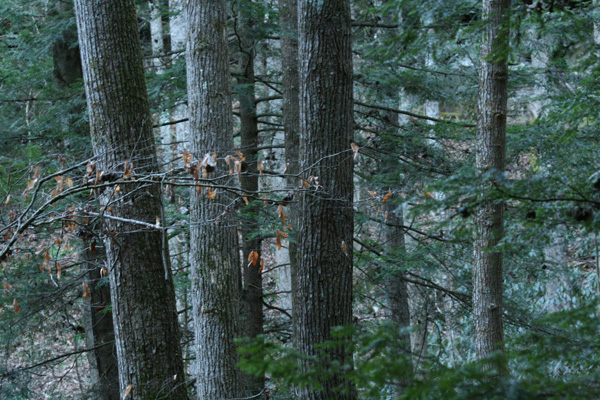
how many trees.... (as per my essay last month)
tender greens in January woods!
A last remaining pile of snow, at the foot of the falls.  I was amazed to see it.  Does anyone else also see a sleeping sheep in its form?
whale rock, the snow in back (not looking as good as in the previous photo)
the bit of snow again, not my best photo...sorry...but I hope this cliff view gives the perspective.


On the way back, another unexpected sight -- the moon one night before full
Here I am focusing on the sycamore...
and now focusing on the moon, a minute later, as I try out ways to make a moon photo!


Sunday, January 1, 2012

two news -- a year and a day

post #66
      I'm so happy to be taking up this blog after a week away, despite all the fun of being with my beloved family over Christmas, represented by this photo of the present received by the 11 month old family member:


      I am grateful for humor -- whether ahead or behind!

     Then, even though this post is my first in 2012, there remain a few bits left hanging from before.  For example, I have yet to share a photo of myself .... but now is the season to bring out one I took about a year ago, on the bank of our pond:


      And I didn't get to say much about the cactus photo on the last post.  I don't know where that bloom came from, since the plant is small and it hasn't yet bloomed again.  It was hard to portray what I had in my mind's amazed eye, but I couldn't miss the opportunity to try.  I did surround the pot with greens, which I don't usually do since I prefer working with views that are as natural -- or "found" -- as possible.  That is what seems to grab me the most intensely.  In that vein, I wanted to show the size of the plant relative to the bloom.  Probably not every photographer would care about that aspect.


    Last month I shared a table with a younger photographer at a Christmas market, and we discovered we like to take photos of many of the same things.  What a treat for me to meet her!  Go, Bobbie!  It reminded me that one photographic goal I still have -- besides learning more about what I am doing -- is to find someone who would like to share the use of my big printer in exchange for helping me learn all the things it can do.  Rural artists have distance challenges, to put it mildly.  Working alone is part of what is important and wonderful, but sometimes there are gaping holes. I am so grateful that my monthly writers group provides so much of the creative support I need, for example, even though they don't know about printers and even if I have to drive 70 miles one way to Lexington to take part. 
      So, one last sharing from 2011 before I sign off.  The 2011 National Book Award for poetry went to one of the women writers in Lexington, Nikky Finney.  Her acclaimed acceptance speech this fall says so much so well.  I am giving the link here in hopes everyone can take ten minutes to see and hear her on YouTube.  Bravo, Nikky, and thanks, thanks, thanks.
       I hope good health and strong dreams are part of this new year for each of you.

Sunday, December 18, 2011

last 2011 post, and the last section of the essay

post #65


section 6: SNAPSHOTS OF THE WORK ON COUNTING ON THE WOODS

         My camera manual tells me that depth of field refers to how much of the picture, from near to far, is in sharp focus.  I get it that success here has something to do with f stops, but everything else comes into play as well -- how fast the lens, the speed of the film, the amount of available light.
        More light allowed in the camera increases clarity almost to the point where the photographs can look more intense than life itself.  Also, by now in my work I am supremely conscious of the wind.  I think about the time of day--nature can be so still at dawn that a fern won't show motion when the lens is left open to show more detail, more depth of field.  Working on this book taught me to see more and to pay better attention.  
        Early on I had felt that I was mainly out of my depth in some field.  Or simply out in left field, no depth about it.  Luckily I had a deadline and a commitment, so gradually, one image by one image, I felt less stranded and less conscious of my lack of formal technical training.  I even began to have fun!
        This book has allowed me to share my love of this place with all the world.  It's the big picture that I got from so many little ones that continues to amaze me.
#   #   #  # 


new life, 2011
new life, 2011


for JOHN KELLEY and all his family and friends

      I wish the world and each one of you the faith that we human beings can learn to live with peace in our hearts and find our inner peace.  Peace in our families.  Peace within nations and between nations and with nature.  We each of bones, blood, brains and sinew can surely become better at building these ways of peace, one moment by one moment. 


Sunday, December 11, 2011

Photography + other parts of one's life

post #64
      Welcome to still more of the essay about illustrating Counting on the Woods -- we're up to section 5, which took place in mid-July 1997.  Next week I will post the last section.  Two weeks from now is Christmas, and I won't do a post that week.  I couldn't give it the full attention I try for, and most folks wouldn't have time to read it anyway!  I will happily return here on New Years Day.
      

       section 5:  I DO HAVE AN OTHER LIFE
     
      One picture left, three days to do it in.  Sounds easy.  Luckily by this point I am so far removed from reality that nothing seems too much.  Not even having Emily's family of four for their first visit, for 36 hours, not even getting ready for a nineteen day trip to visit family, having a potluck for 23 people the third night, or making a four hour round trip to Lexington to drop off two last rolls of slides.  (Thank goodness the book's author is able to pick them up later, sort through them, and send some off to New York.  Which ones, I wouldn't know.)  Eight trees?  What could be challenging about that?  I am surrounded by one hundred acres of trees.
      Of course there is a clear reason why this shot is the last one.  I have tried many tree views, but it feels impossible to get only eight.  Or just nine.  Or five and five.  My original innocent Dark Ages plan was to find the tree groupings and then put the kid in one of the trees.  But I was being "stumped" by such logic.  I had already tried ridge lines, cow fields, inner woods, east-facing wooded hillside as well as west-facing ones, and fortunately, field edge trees.  
      It turns out I had at some point been on the edge of some field and had made a shot of eight trees that worked pretty well, though I felt I could do better.  [Remember, the Kyle-in-the-tree photo I want to use ended up showing him in two trees, so I now needed eight in order to match the ten trees in the words.]  But where had I been to find that grouping?  I'm  surprised it's so hard to relocate the precise place.  I usually remember clearly where I've been and what I saw there.
      This is when the three days actually make a difference.  My brain had time to sift, and I had time to reenact some earlier tripod locations.  All that other stuff in my life simply went on without my full participation, and of course with no problems.  The kids and my husband did the potluck, Emily entertained her family, our neighbor, Michelle, stayed in our house while we were gone and cleaned the house at the beginning and at the end of her stay  [thanks again, dear friend] -- and broke up with her boyfriend!
      What I finally discovered was that those eight trees could be viewed only through my trusty 300 mm lens.  The image on the slide doesn't exist to the natural eye.  Luckily that field was only a short walk from the house.  And I found the place in time to film the trees in the Sunday evening light --  leaving the potluck briefly --  and again early the next morning, the last day I could film, the day I went to Lexington. 
      Someday the world will see a straightforward photo of eight tree trunks, one picture out of many, in a book, one of many, many.  But I will always count eight trees as a miracle.

a study for the trees page
a snap of the final result: two plus eight 
hard-to-count trees on this hillside!
hard-to-count trees in this summer's steamy forest


turning to the page before: nine vines, earth to sky they climb

Sunday, December 4, 2011

the story behind a single photograph in Counting on the Woods

post #64
Kyle in the sycamores

section 4 of the essay Snapshots of the work on Counting on the Woods:

THE LAST PHOTO OF KYLE

      Every photograph comes with a story, but this one, the penultimate photo in the book and in the taking, Kyle in two trees, this one has a saga.  My work of hands and eyes is now to be in these words.
      Think Tuesday night -- only five days before I had to finish the book.  I realized the light would be great, but by the time I called Kyle, his mom said he was "out."  Wednesday morning, he agreed to come over to my place if I could pick him up at 7:45 that evening.  But when I drove over to his house, a mile away, no one was home!  Looking around for him did give me the chance to make note of a pair of sycamore trees growing on the downhill side of the tobacco field behind his house.
      From my journal, written the next day:  "The evening was again light lovely.  I came home, did the equipment collage photo at the pond with [my son] Eric and [his girlfriend,] Emily, then I phoned Kyle.  He was home by now, alone, but 'too tired' to come over.  [Help!]   [Because] I had seen his sycamore trees earlier.... I asked him if it would be all right if we came over there instead.  OK, he said.  I hollered at Eric, and we three raced to get there.  By now it was 8:20 p.m. [in mid-July.]  Once Kyle located his shoes and his blue jacket -- always worn for the photos -- Eric helped him get up in the tree while I set up the tripod in the tobacco field mud, [trying not to damage the young plants.]  Emily held the stuff I would usually place on the ground around me.  
     "I tried several perspectives, but didn't think to try overexposing to compensate for the bit of sky in some of the photos."  Then I added in the margin " The light was o.k., but not as wonderful as earlier [that evening.]"
      Eric and Emily went to Lexington the next day, two hours away, with that single roll of film, and they returned with the slides.  Relief and wonder.  The last shot of Kyle is just right for the book.  I love it.  It is luminous.  The light was ideal.  Kyle has a wonderful expression on his face.
      I phoned Kyle right away to tell him that we got what was needed and he didn't have to be in any more photos.  Now all that was left for the weekend was eight trees to go along with the two in the sycamore slide.  It was for the page needing exactly ten trees. Just because I had been thinking that the configuration would be one and nine, had we used our single sycamore, didn't mean I couldn't readjust.  Change happens.  Hey, one picture left, three days to do it in!

NEXT WEEK, section 5, called I Do Have an Other Life.  NOTE: I did an earlier post about Kyle, post #41. 

      Here are two other sycamore photos, the first a practice shot for the one that was used in the book, and the other a winter scene with our big sycamore tree in the middle; the light comes from our chicken house.

practice shot


chicken house light, with our sycamore in the middle of the photo

Sunday, November 27, 2011

Kyle's sections of the essay, part 3 (with part 4 next week)

post #63
      Before I return to my essay about the work on Counting on the Woods, I want to acknowledge this four day weekend in Thanksgiving territory by hoping everyone here has been having some thankful times.  (I'd think some of my readers in other parts of the world may have a hard time understanding what this American holiday is really all about!)  In any case, the date does give me a good excuse to express my appreciation for those of you who have believed in me, encouraged my art, enjoyed my images -- and helped me get better at what I do.  Your support continues to mean a whole lot.


      Now, back to the essay, Snapshots of the work on Counting on the Woods.  The intro and part 1 are in post #60, part 2 is in post #61, and the words to the poem/book are in post #62 (last week.)  The essay was completed in 1999.


part 3: ONE KID OR TWO OR NONE

      How many kids should appear in a counting book?  This deceptively simple question would not be resolved until three days before deadline, but for the duration I had a wonderful excuse to spend time with Kyle.
      Kyle had always been my neighbor, but I really didn't meet him until I did a presentation at his school the previous fall.  I was showing slides I had taken in our shared eastern Kentucky county.  I didn't expect that there'd be any particular connections until a quiet spoken boy shyly said that the man in one of the pictures was his grandfather.  I took an immediate liking to this red-haired ten year old, and, after the class, I persisted until I found out who he was. Kyle McDaniel.
      Kyle's extended family members surround the land were we live.  His eldest brother and family live on the edge of our farm, in the house where Kyle was born.  The cemetery there holds two of his four brothers; both died as babies.  His first cousin once removed, Larry, lives across the road from us, where I lived when I came to Kentucky 31 years ago.  And his grandparents own the adjoining farm.  Kyle actually lived then about a mile away, on a road often mistaken for our driveway.
      I thought of Kyle right away that spring [1997] when I began imagining including a child in the the photos for the book.  It turned out working with Kyle was an even better idea than I had anticipated, besides the fact he was small for his age.  He was able to understand the project and actually looked forward to the few times we went out in the woods together.  Each of the three or four times we were together I made at least one good photo.
      This was fortunate because getting Kyle, his schedule, the weather and my schedule to mesh was a major accomplishment.  Not only was he very independent for his age, but he could be helping in the family tobacco growing operation, when sometimes they all worked outside until dark, too late for photos.  Then one weekend in June he drove to Michigan with his aunt for a cousin's high school graduation.  Another time he traveled to West Virginia.  I worried he'd stay gone for weeks, and I had a late July deadline!  Also, I finally figured out he could easily be home alone or out somewhere on his four-wheeler, the reason he wasn't available during several marvelously lit spring evenings.
      Kyle ended up being the only child shown in the book.  I can't imagine it being any one else.  I can't imagine it any other way.  In fact, the last photo I took of him deserves its own story.  [See part 4 ... next week.]

one path, a stick for a staff


Kyle watching our hummingbirds, photo used on the book's dust jacket


NOTE: For those of you in northeastern Kentucky, here is a reminder that I will be at Morehead State University's Arts and Crafts Fair, 9 - 4, Saturday, December 3, sharing a booth with my friend, artist Jennifer Reis.   Mention this blog, and I'll give you a 10% discount -- with appreciation for your alertness!!

Sunday, November 20, 2011

Counting on the Woods: the words

post #62
      This week it occurred to me, finally, that the remaining sections of the essay will make a lot more sense if I share the words George Ella Lyon wrote for the book.  So today's post will lay out her 76 words, which includes the title, Counting on the Woods.  After getting the go-ahead to be the photo-illustrator (with a contract and an advance,) those words were what I was given, to do with what I thought I could.  Figuring that all out and actually doing it is what I write about in the essay.

       So, here's some perfect imagination time, folks.  What do you see in your mind's eye when you read the words?   What would you ponder were you handed this poem, spread over two typed pages?  What would you try to look for?  As for me, I was thinking "It's already the end of March", and "I have never done this before" and "Thank goodness I live where I do [in eastern Kentucky.]"  Just know that I was grateful the words were each one wonderful and that our editor, Dick Jackson, is skilled at expecting one's best work.  His instinct is to envision the possible.  

Counting on the Woods
                                                                               to the waterfall
                                                                          given for all
                                                
One path, 
     
     a stick for a staff.

Two birds, 
      
     daybreak's words.

Three bugs 
     
     in the moss rug.

Four worms, 

     how the earth turns.

Five nests

     where new ones rest.

Six tracks.

      Who's coming back?

Seven stones, 

     the little creek's home.

Eight flowers 

     fed on dirt and showers.

Nine vines,

     earth to sky they climb.

Ten trees

     whose innumerable leaves

    clean the air for everything that breathes.


     That's it.  Totally.  1997 did happen to have a cool, wet spring, which meant a longer awakening season than most other years, and I did decide to show a child in a few of the photos, though you may have noticed there is no mention of one.   Other such helpful things evolved as well.  But a lot of that is in the essay, which I will continue sharing next week.  All in all, an unusual way to become a photographer, but, hey, if it works, go for it!

to the waterfall given for all

Sunday, November 13, 2011

Snapshots essay, part 2 (of 6)

post #61
     Before I start in on section two of my essay Snapshots of the work on Counting on the Woods, I'd like to confess that just yesterday my daughter showed me that nowadays we blog viewers can click on any photo in a post -- and, presto, all the photos in that post show up in a row along the bottom of the screen AND can be seen in a large size after being clicked.  Probably every one of you reading this already knew about this added blogspot innovation, but I did not.  Last week I did increase the spread size on the page, but if this causes problems for anyone, please let me know!  I will even give you my email address for the first time should you need to contact me:  annphoto@mrtc.com.

OK, here is the essay's section 2,  BOX SCORES

      One question I have never fully resolved is whether it counts as work to sit outside--in a box--for an hour or two, near a bird place.
      The cubicles of the modern corporation would seem spacious in comparison to the box I ended up in, but at least they are clearly a place where people go to get paid to work.  Why else would they be tolerated?  The same clarity doesn't apply to a cardboard box.
      And what does the bluebird I'm taken by know of business plans and bottom lines?  I am not even certain what it is I expect of him, except that I have tried photographs of this bird, this post, this nest before.  I was always too far away.  Not connected enough.  
     So my only plan now is simply to get closer.  I suspect universal truth, but what I think about is cost efficiency.  Would this box effort mean I am doing more work, less work or none at all?
     I could figure out that setting up the box is definitely work, especially when its size most closely resembles the desk chair that it once held.  Getting tripod, camera, stool and body to fit inside is be a proper chore, but does the same hold true for just sitting there?  I was shooting at that time with very slow film, Velvia (ISO 50), and I was inside the box for a dawn-breaking hour and a half.  I needed to remain alert, of course, and move my right hand every so often to click the remote control, but otherwise just sit, stay calm, and sit some more.  
      The end result has made me willing to risk not "working" ever again.  One of my favorite photographs for the book.  I hope the happy coming together I experienced was the same somehow for my bluebird.  It seems he knew his part all along, and I learned mine.  Now, if only the questions I always ask about life could achieve equal clarity and sharpness where I to pay similar attention to situation and focus.

eastern bluebird at his nest, from Counting on the Woods

eastern bluebird, on the post containing the nest, but "always too far away!"  It was more like a test shot than a photo I would use for a note card or in the book, but it's still important, which is why I show it here today.


I call this more recent bluebird photo "No, YOU bathe first."
Note:  In my writers group, where I received valuable feedback to early drafts of this essay, we still call that important work we all must do of getting truly connected to our work getting closer to your bluebird.  Good luck to everyone doing just that!

Sunday, November 6, 2011

Writing about making photos

Post #60
      For the first year of this weekly blog I have consciously chosen to focus on the place where I live -- northeastern Kentucky, in Appalachia -- and on what I learn from making photos here (and sometimes here and there.)  I haven't really given out my full name -- though it is not a secret -- or solicited fame and fortune.  
     However, now I want to share the essay I once wrote about making the photo illustrations for the book I mentioned in my last post, Counting on the Woods, a poem by George Ella Lyon.  This book was published in 1998 by DK, Ink, and our editor was the remarkable and risk-taking Richard Jackson.  I mention the risk part, because, back then, I was not a professional photographer.  I became one because of the learning I did while working those three months in 1997, which I write about in the essay.
     OK, so my name is Ann W. Olson, my web page is www.annwolson.com (which is in revision at the moment), and I do sell photos, photo note cards, and hardback copies of the book, which is currently out of print.  I have 100 copies left, but the book is in many a library across the country, in several text books and a big reader (though in an altered format.  Don't get me started.)

     The essay has six sections.  In keeping with my general goal of having these posts be short, I am planning to take six weeks to get the whole piece shared.  Today is the intro and section one.


     Snapshots of the work on Counting on the Woods


     All spring in 1997 I learned to see by taking photographs for a counting book for children, written by George Ella Lyon.  I spent dawns and dusks outside, I used a tripod, I discovered I could understand  signals from creatures and plants in the woods.
      Ever since then I have been trying to figure out what happened.  Amazing to me is that through the struggle to learn about depth of field on my camera I increased my inner depth of field.
      By the end of those three months, I was finding pictures that could only be seen through the lens.  What's out there didn't change, but I found the world had more possibilities.  Eyes first, then lens in addition, trying to imagine which vantage would interest a child.  What would work for the book. New ways of seeing. 

1. Uses of a Tripod 

      I never owned a decent tripod until April, 1997, yet almost instantly I became a tripod convert.  It is a wonder tool, a full partner in the photo taking process.  My tripod makes me look good.
      Its intended use is to prevent camera shake when light is low.  However, a tripod is a handy aid in many other ways as well.  For example, it provides a sturdy place to hang the clothes one is shedding in the heat of the morning; tree branches would bend and break.  Also, it affords an illusion of protection against snakes and bears and becomes a one time only expense in one's personal fitness program.
      Furthermore, the multiple levers and handles keep engineering and conceptual skills sharpened.  The tri this and tri that system actually makes sense after awhile, and the reward for more trying is that the tripod becomes less trying.
      There is no better way to be steady enough to allow light to work its magic.  This anchor is now what I miss most when I am away from home and can't take it with me.


      ^ ^ ^ ^ ^ ^

Notice my boot prints near the tripod -- as well as Canada geese prints.  (The camera is not my regular camera.)  Then there are those baggies on the tripod legs....


the cover of the book